Archives

gravatar

The Silence of the Sheep, the Bleating of the Goats

Those were the only sounds that greeted the large force of Philippine National Police sent by ARMM Chief R. Goltiao (who blithely told Pinky Webb about it on the noon time news) as they descended on the crime scene in Tipo-tipo Basilan to serve 130 arrest warrants for suspects in the ambush killing, torture and beheadings of 14 Philippine Marines searching for kidnapped Fr. Giancarlo Bossi on July 10. The warrants for arrest were issued last week by Judge Leo Principe of Basilan.

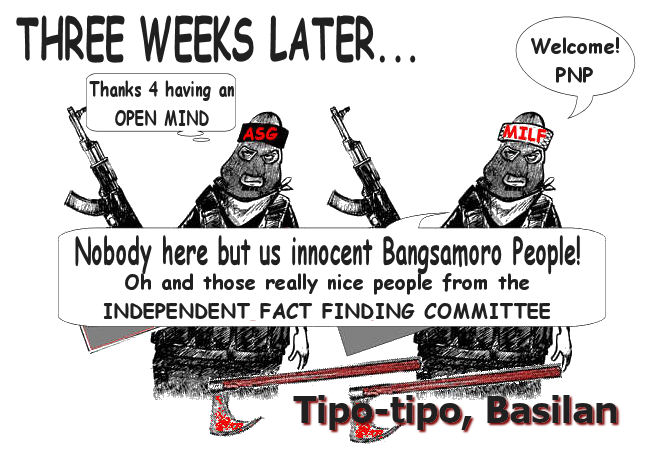
Aside from "old women and young boys" the crime scene was said to be deserted except of course for the elements of Malacanang's newly formed tripartite investigating committee (one third of this being MILF representatives, ngek), who were there ahead of the police and waving them off to go back home...they need 24 more hours to tie up the loose ends of their own "independent fact finding" committee, which investigation started last Friday after the President's command conference with them in Zamboanga, far, far away.

Just behead me already!

Meanwhile, Dr. Nando Barandino, medico-legal expert of the PNP in Basilan, and a former captive of the Abu Sayyaf, reports that at least two of the fourteen dead Marines showed signs of torture before they were beheaded during the autopsy he performed on them. He makes the strongest case for an end to this savagery, by recalling the sad recent history of decapitation on Basilan.

Is it any wonder these savage crimes go on unabated when they have never been properly punished and the Rule of Law and Order established over an essentially lawless and bandit-warlord-dominated place.

I think I'm beginning to like Gordon Brown's statement following two days of talks with George W. Bush at Camp David. He said, "Terrorism is not a cause, it is a crime against humanity."

I think we SHOULD give the Sword of Justice a chance instead of the endless cycle of WAR and PEACE in Mindanao.

I don't think the the Ceasefire Committee really has any jurisdiction over what is essentially a CRIME SCENE. Let them have their peace talks in Malaysia! Let the police their job. Let the Law rule over all men, all religion, all armies, all ideologies.

I think with the Human Security Act, we really have a chance to create a viable alternative strategy in managing our unique complex of insurgencies, secessionists and nihilists.

By criminalizing terrorism, we delegitimize the terrorist tactics of the communist insurgency with its armed struggle, and the Moro separatists, without denying them their right to espouse political and ideological causes in a peaceful manner.

The War on Terror becomes the challenge of Law Enforcement, which now offers the clearest path to real peace and order.

Not the endless Peace Talks that have produced nothing but war without end.

gravatar

The Senate Spin Cycle


MAR ROXAS has just served notice that he is indeed running for President of the Philippines in 2010. The Liberal Party's leader-emeritus, former Senator Jovito Salonga introduced him recently as the next President of the country. In what ABSCBN News billed as "a rare political outburst" Senator Roxas last week decried the ironic fate of the Opposition in the Senate, which does not control it, despite having clearly won the people's mandate in the midterm elections last May.

Here is how Senate President Manny Villar, in his acceptance speech to Senate colleagues last week, interpreted the May election results:
Over the years, the Senate has been the subject of much criticism and doubt, leading many to conclude that it is best to abolish it. However, the recently concluded senatorial elections only emphasized the Senate's crucial role in the balance of power among its co-equal branches of government. The overwhelming consensus was that the Philippine Senate must maintain its institutional independence, beholden to no political power but to the sovereignty of the Filipino people. No less than the will of the people validated this.
He also throws in as an after-thought later in the speech that,
And yes, we will continue to carry out our investigative duties as part of our power of oversight. Shenanigans in government should never be condoned.
Shenanigans? Is that what he thinks oversight is all about? Shenanigans? And to think he was the flag bearer of the Genuine Opposition.

Oh well, some say it looks like an old-style pre-Marcos Liberal Party versus Nacionalista party election shaping up in 2010. But I think Mar's gonna have problems with Loren and Ping in the Minority, just as Manny will have problems with Kiko and Chiz in the Majority, while still pleasing Gloria and JPE. Maybe Chiz will get Ways and Means and Alan Peter Cayetano the Blue Ribbon. Or maybe not, but I don't think the Senate configuration is fixed in stone by any means. It could change at any time depending on what promises are kept and what events transpire.

gravatar

Basilan Judge Issues 130 Arrest Warrants For Murder and Beheading of Marines


ABSCBN News anchor Tony Velasquez reported on his show Crossroads Friday night in Manila, Basilan Judge Leo Principe of the 9th Regional Trial Court has issued 130 WARRANTS OF ARREST against those persons responsible for the ambush, killing and beheading-mutilation of fourteen Philippine Marines who were returning to their own camp after a fruitless search for Father Giancarlo Bossi (a kidnapped Italian priest mysteriously released a week ago.)

On Friday also, President Arroyo conducted a "command conference" on the Basilan beheadings. General Rodolfo Garcia, chief negotiator on the RP Peace Panel describes the conference and says some things about Judge Principe's warrants for arrest that gives me a sinking feeling about how this whole sorry affair is going.


I assert that Tipo-tipo is now a CRIME SCENE with Judge Principe's finding of probable cause in the murder and beheading of the Marines against 130 suspects being the beginning of what I hope will be a full prosecution under the Human Security Act. Judge Principe in effect establishes the existence of thE first element of the crime of terrorism: SAVAGE MURDER.

gravatar

Basilan Beheadings Were Terrorist Crimes Under the Human Security Act of 2007

Now’s the time to understand the definition of the crime of terrorism

The Human Security Act of 2007
defines a new category of criminal activity called terrorism. In the local punditry and bloggerdom, the definition of terrorism has been a long-running controversy. Generating much of, and then pointing to these widespread disagreements, some here are saying that the definition in the law itself is VAGUE.

This point is being repeated by a lot of people in columns, broadcasts and editorials. Whereupon they usually say something that often suggests to me they’ve never READ the effin Law, but knowing most of their audience hasn’t either, they think they can get away with saying something stupid. Well, they can, with most people. This simple statistical truism is the Trade Secret of pundits and journalists in the Philippines.

I know why some of these folks are saying that the definition in HSA 2007 is vague. It is because terrorism is not a SIMPLE crime that we are already familiar with. But--and this IS the confusing part for most people—the first element of the COMPLEX crime of terrorism is a precisely defined set of just such “simpler” crimes: piracy, rebellion, insurrection, coup d’etat, murder, kidnapping, destruction, arson, illegal use of toxic and radioactive substances, hijacking, and illicit dealing in firearms, ammo and explosives.

After calling the definition vague, many critics usually segue into the line of argument that the anti-terrorism law is UNNECESSARY because we can already prosecute these component crimes under the Revised Penal Code and other laws cited in H.S.A. 2007.

But the argument is facile. One could say the exact same thing about other COMPLEX crimes like Plunder and the Organized Crime statutes, which also defined new categories of criminal activity that were themselves made up of such simpler crimes. For example the Plunder Law being used to prosecute former President Joseph Estrada is defined as “series or combination or clear pattern” of such acts as corruption, graft, estafa, embezzlement, theft of public funds, etc. Yet none of these same critics of 2007HSA would call the plunder law “unnecessary” just because we could prosecute for the component crimes. Indeed as Estelito Mendoza recently explained on tv, plunder is NOT just those component crimes, but the series or combination of them. In other words, the whole of the crime of plunder is more than the sum of its parts. Take a complex mechanical contraption, like an automobile. It is clearly more than just the engine, tires, doors and electronics put together. It is the entire assembly we call a car that is the whole thing. Likewise terrorism is more than just the odd train bombing in Manila, or blown up super ferries, or disappeared ideological rivals, or the occasional beheading or ten.

But here is the definition of terrorism from HAS-2007, without the long list of component crimes:

SECTION 3. Terrorism. – Any person who [1] commits an act punishable under any of the following provisions of the Revised Penal Code:
[…enumeration of laws punishing the component crimes of terrorism…]
[1] thereby sowing and creating a condition of widespread and extraordinary fear and panic among the populace, [2] in order to coerce the government to give in to an unlawful demand shall be guilty of the crime of terrorism and shall suffer the penalty of forty (40) years of imprisonment, without the benefit of parole as provided for under Act No. 4103, otherwise known as the Indeterminate Sentence Law, as amended.
The items [1], [2] and [3] are nowadays referred to as the elements of this new crime of terrorism and I am sure there will be much more discussion of the definition in the months and years ahead.

One of the interesting controversies that will surely arise in regard to Element [2] is whether or not a crime of terrorism exists if the intent to sow and create a condition of widespread and extraordinary fear and panic among the populace, fails.

For surely, it is in the public interest that no matter what chaos or mayhem or destruction some future terrorist causes, that the populace not succumb to fear and panic.

So my answer to the question is NO, it is not necessary that there actually BE a reaction of widespread fear and panic to some terrorist act. It is enough that the intent to cause such fear and panic be proved. In general this would seem to be a very difficult thing to do. But I’ve come to realize that it might not be so hard in certain cases in which the acts themselves evince the presence of such evil intent. For example, if someone threatens to poison the water supply or disseminate radioactive waste, or to release a deadly biological agent, that would suggest to most reasonable men an intention to sow widespread fear and panic.

Element [3] is even more clearly about intent and motive as being a defining characteristic of the crime of terrorism (which makes the crime very difficult to prosecute and prove, UNLESS, it becomes obvious in the outrageous nature of the act itself that there is a clear intent to coerce the government to give in to an illegal demand.

This element is the political or ideological element of the complex crime of terrorism. Taken in the abstract, this may seem like a sticky subject, again unless the acts and context involved are redolent of political coercion of the government, such as in the cases of insurgents (CPP-NPA), secessionists (MILF), and global jihadists (Abu Sayyaf, JI, AQ).

As with most laws, it is not theoretical disputation over HSA2007 that will settle things and make them clearer. It is real events involving real people that will clarify what the polity shall make of its Law and the definitions therein.

THE BASILAN BEHEADINGS AS A TEST CASE FOR HUMAN SECURITY ACT OF 2007

Counterterrorism Blog has an excellent background summary on this incident which occurred on Tuesday 10 July 2007 near Tipo-tipo on Basilan Island in southern Philippines:
On 10 July, a group of 80 Philippine Marines were patrolling Guinanta village in the Tipo Tipo area of Basilan, Island, just south of Zamboanga, when they were ambushed by members of the Moro Islamic Liberation Front (MILF) and quite possibly members of the Abu Sayyaf Group (ASG). 14 marines were killed, 10 of those were decapitated, and nine more were wounded. That the MILF and the Armed Forces of the Philippines (AFP) clashed is not in doubt and both have acknowledged the conflict. But those are about the only facts the two sides agree.
ABSCBN NEWS lists the names of the Philippine Marines killed and mutilated:
The Marines killed in that clash were Privates First Class Emmanuel Beup, Reuben Doronio Jr., Freddie Palma Jr., Elizar Semeniano, Arjorin Alezar, Jhonard Allanza and Wilfredo Lamban; Pvt. Emilio Lachica Jr.; Cpl. Russel Panaga; Sgts. Rey Callueng, Gerardo Licup and Cayetano Simbangon; S/Sgt. Bernard Abes and T/Sgt. Noel Bautista.
This crime qualifies as good test case for Human Security Act. Many of those who have opposed the Act on political and ideological grounds are really at at a loss about how to deal with the Basilan Beheadings. I think most them realize it IS an almost ideal case to test the validity and Constitutionality of the HSA, and that the beheadings really ARE terrorist crimes.

But if such a terrorist crime were to be successfully prosecuted this close to the HSA coming into effect, it would surely refute many of the arguments of those who oppose it.

I think this is precisely why they refuse to admit the obvious, that the Basilan Beheadings were terrorist crimes, and why they want the whole thing dealt with again in the quagmire and quicksand of PEACE TALKS.

They cannot bring themselves to admit how RIGHT the law is on terrorism.

gravatar

Maximum Restraint and the Rule of Law


It has not yet dawned on a lot of people that the advent of the HUMAN SECURITY ACT of 2007 changes the character of what I call the TERMS OF ENGAGEMENT between the Philippine Government and its various enemies in the Communist Insurgency (CPP-NPA), in Moro Warlord Secessionism (MNLF, MILF), and in the Global Jihad (Al-Qaeda, Jemaah Islamiyah, Abu Sayyaf, Rajah Solaiman Movement).

For one thing, I believe HSA 2007 effectively decouples the so-called PEACE PROCESS (which has resulted in nothing but war without end), from the imperatives of LAW ENFORCEMENT.

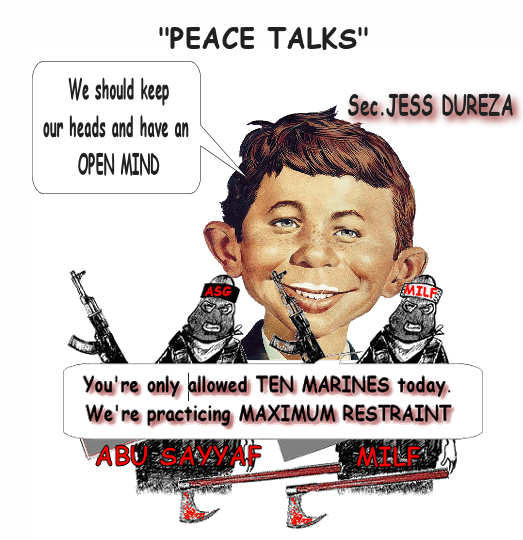
Whatever legitimacy one wishes to accord the so-called Peace Talks with any of the insurgents, rebels and beheader brigands, it ought to be accepted by more government officials, especially the likes of Jess Dureza, who is the Cabinet Officer in charge of the Peace Process, that they are only in charge of the peace process, and not the whole government responsibility when it comes to dangerous organized private armies and irregular guerrilla forces.

Jess Dureza, excuse me, is not responsible for the discharge of the duties of the Philippine Military, the Philippine National Police and other law enforcement agencies of the government. He is merely in charge of the those tete-a-tetes with Joma Sison and al-Hadj Murad. I wish him all the luck and hope his efforts pay off.

But he has no right to be dictating policy or telling the Armed Forces and the Police how to do their jobs, or when and where. We must be a nation of laws and not Alfred E. Neuman.

gravatar

Comparison of the Panganiban Formula and the Rizalist Algorithm Applied to the 2007 Party List Results

Upon the suggestion of Nicholas, I am now publishing a comparison of the Panganiban Formula versus the Rizalist Algorithm in deciding how to award House Seats to the Party List organizations that ran in the May 14 midterm elections, in which 29,984,421 ballots were cast, out of which a total of 15,703,067 or 52 percent contained a vote for one of the Party List groups. The Official Comelec Canvass shows the results for 93 Party List organizations that ran under the Party List System. Seventeen of them each garnered 2 percent or more of the 15 million votes that went to the Party List System, with BUHAY topping the race at 7.45% of the Party List votes.

As the "First Party" under the Panganiban Formula, Buhay has indeed been awarded one seat for exceeding the 2 percent threshold and two additional seats for scoring above 6%. The "PANG" column in the Table below shows how many seats are awarded to the other parties based on the Panganiban formula, which is calculated by taking the ratio of votes garnered by each party and that garnered by the First Party multiplied by the number of seats awarded to the First Party (in this case, 3). But as a result of the Panganiban Formula, only TEN of the Party Lists that ran will get seats, and SEVEN of those that met the 2% threshold WILL NOT get a seat. Under the Panganiban Formula, only THIRTEEN SEATS will be awarded to the Party List System, even though 52% of the voters chose a party list on their ballot.


RANK PARTY VOTES PERCENT SEAT PANG RIZ
1 BUHAY 1,169,165 7.45 3 3 2
2 BAYAN MUNA 976,364 6.22 2.505 2 2
3 CIBAC 755,393 4.81 1.938 1 2
4 APEC 621,092 3.96 1.594 1 2
5 GABRIELA 620,890 3.95 1.593 1 2
6 A TEACHER 486,390 3.1 1.248 1 2
7 AKBAYAN 460,968 2.94 1.183 1 2
8 ALAGAD 423,071 2.69 1.086 1 2
9 BUTIL 409,132 2.61 1.05 1 2
10 COOP-NATCCO 407,417 2.59 1.045 1 1
11 BATAS 384,961 2.45 0.988 0 1
12 ARC 373,626 2.38 0.959 0 1
13 ANAKPAWIS 369,023 2.35 0.947 0 1
14 ABONO 339,888 2.16 0.872 0 1
15 AGAP 328,600 2.09 0.843 0 1
16 AMIN 316,249 2.01 0.811 0 1
17 AN WARAY 315,527 2.01 0.81 0 1
TOTALS


22.47 13 26
Nb: 29,984,421 ballots were cast on May 14, out of which a total of 15,703,067 or 52 percent voted for a party list candidate.

Nb: The figure in red 22.47 represents the mathematical number of seats that should go to the Party List System under strict proportionality, but of course it cannot be met exactly due to the four constraints. But the number of seats awarded under the Rizalist Algorithm is closer to this "ideal" number of seats than the niggardly 13 awarded under the Panganiban Formula.


Under the Rizalist Algorithm, the first step is the calculate the TOTAL NUMBER OF SEATS that are available for award to the qualifying party list organizations, equal to the percentage of the ballots with party list votes multiplied by twenty percent of the authorized maximum number of House Seats (250 under the 1987 Constitution and never yet changed by Law). Thus for 2007, the Rizalist Algorithm would make 26 House Seats available for awarding to the party list groups, subject to the constraints of the Four Inviolable Parameters of Panganiban (proportionality, 2% threshold, 3 Seat maximum and 20% of House). As seen in the Table, the Algorithm would award 26 seats as follows: all 17 party lists with at least 2% of the vote will get at least one seat; and the Top 9 ranking parties will each get 2 seats. NO party gets three seats in 2007 under the Rizalist Algorithm.

The Table of results above clearly exposes a major shortcoming of the Panganiban Formula. Although it purports to uphold the Four Inviolable Parameters, its implementation has resulted in seven parties not being awarded seats despite having garnered 2% of the Party List Vote, and despite the fact that giving them each at least one seat, does not in fact violate any of the other three parameters.

This indicates that the Panganiban Formula is not an "optimal" implementation of what is essentially a problem in LINEAR PROGRAMMING and optimization. It actually violates the principle that a party list qualifies for a seat by gaining a threshold of 2%, and should get one if it does not cause a violation of the other parameters.

gravatar

Proportionality--A Critique of the Panganiban Formula for the Party List System


HOW MANY MEMBERS OF THE LOWER HOUSE ARE THERE?

This is a surprisingly tricky question to answer with any sort of precision because while the maximum number of Party List Representatives is more or less fixed, it is always possible for there to be ZERO party list reps if none of them meet the 2 percent threshold. The Lower House has two kinds of Members: District Representatives who are elected by voters in local Congressional Districts and Sectoral Representatives elected by the voters at large under the Party List System. During the 13th Congress there were 230 Members in all, with 23 Party List Reps (10%) and 212 District Reps (90%).

The main point of this post is that the TOTAL NUMBER of seats in the Lower House that ought to be awarded to the Party List System should be proportional to the number of voters that participate in the Party List System by casting a vote for it. As it stands under the Panganiban Formula the total number of seats awarded doesn't depend on whether 1,000 voters or 10 million cast ballots for the Party List!

The 1987 Constitution states:

Section 5. (1) The House of Representatives shall be composed of not more than two hundred and fifty members, unless otherwise fixed by law, who shall be elected from legislative districts apportioned among the provinces, cities, and the Metropolitan Manila area in accordance with the number of their respective inhabitants, and on the basis of a uniform and progressive ratio, and those who, as provided by law, shall be elected through a party-list system of registered national, regional, and sectoral parties or organizations.

(2) The party-list representatives shall constitute twenty per centum of the total number of representatives including those under the party list.

Unlike the number of Congressional Districts which is known before the elections and fixed by law, the actual number of seats awarded to the Party List is variable and depends on how well they do against each other.

Here is a curious fact. The NUMBER OF SEATS in the House of Representatives that will actually be occupied by Party List representatives after each election is NOT KNOWN until after the election results are tallied, under the present system which is called the Panganiban Formula. Curioser, under the Panganiban Formula the total number of Congressional seats awarded to the Party List System does NOT depend on the total number of votes cast at-large for the Party Lists but only on their relative performance against each other.

In Law, Mathematics and the Party List System former Chief Justice Artemio V. Panganiban gives an authoritative summary of the procedure now in use for implementing the Party List System in the Philippines:

The Panganiban Formula: Simply stated, the initial step, under this methodology, is to determine the additional seats to be given the party obtaining the highest number of votes. If the topnotcher or “first party” obtains four or more but less than 6 percent of the total votes cast, it gets one more seat. If it garners six or more percent, then it gets the maximum two seats. The additional seats to be given the rest of the qualified parties can be “proportionately” computed by dividing the number of votes of the concerned party by the number of votes the topnotcher garnered, multiplied by the number of seats allocated to the topnotcher.
Those four parameters are derived from both the 1987 Constitution's pertinent provisions and R.A. 7941 (The Party List Law):
First, the twenty percent allocation—the combined number of all party-list congressmen shall not exceed twenty percent of the total membership of the House of Representatives, including those elected under the party list; “Second, the two percent threshold—only those parties garnering a minimum of two percent of the total valid votes cast for the party-list system are ‘qualified’ to have a seat in the House of Representatives; “Third, the three-seat limit—each qualified party, regardless of the number of votes it obtained, is entitled to a maximum of three seats, that is, one ‘qualifying’ and two additional seats; (and) “Fourth, proportional representation—the additional seats which a party is entitled to shall be computed ‘in proportion to their total number of votes.’”

To see that the Panganiban Formula does not take into account the total number of votes cast for the Party List System, consider a very simple example. In Election Year No. 1 a total of 100 million voters cast ballots. Of this number only 10 million voters or 10% of the electorate cast votes for the Party Lists. Suppose that during this election only one Party List group breaks the 2% threshold, garnering let us say 2.1% of all the votes cast for the Party Lists, while all the others get less than 2%. In this case it is very clear that the total number of seats awarded to the Party List System in that election will be ONE SEAT.

Now suppose in a subsequent Election No. 2, that again 100 million voters turnout to cast ballots, but this time 20 million of them, or 20% of the electorate, decide to vote for a Party List group of their choice, twice as many in absolute numbers and percentage wise as in the previous election.

Suppose further that in Election No. 2, EXACTLY the same results obtain: the same party list gets 2.1% of the votes cast for the party-lists, whilst all the others garner 1.9% of the votes cast for the party lists.

Thus in Election No. 2, despite the fact that every single party list got twice as many voters casting ballots for it , despite the fact that twice as many voters cast ballots for the Party List System in Election No. 2, the Party List System will still only get ONE SEAT under the Panganiban Formula, same as in Election No. 1!

I think that this result puts into serious doubt the claim made by the former Chief Justice Art Panganiban that his Formula obeys the Principle of Proportionality in an optimum way. One curious consequence of his Formula, for example, is that it gets EASIER to win a Party List seat as the number of votes for the Party List System as whole goes down because it needs a smaller absolute number of votes to get 2% of the smaller total number of votes cast for the Party List System. In other words, it gets easier to be elected through the Party List System the LESS the electorate participates in it! Conversely, qualifying party lists are not rewarded proportionally under the Panganiban Formula for even 100% improvement in their actual vote totals from one election to another.

Is there a viable alternative to the Panganiban Formula? Yes! Here it is...

RIZALIST'S ALGORITHM for the PARTY LIST

STEP 1. The first step in this procedure is to determine from the election results HOW MANY seats in Congress have been won by the Party List System. The number of seats won by the Party List System shall be equal to one-fifth of the maximum number of seats in Congress (as of 2007 this maximum number is 250 as set by the 1987 Constitution and has not been increased or decreased by Congress since.) MULTIPLIED BY THE PERCENTAGE OF THE VOTERS WHO ALSO VOTE FOR A PARTY LIST CANDIDATE. Thus the Party List System will be entitled to the full twenty percentum or fifty seats only when 100% of the voters cast ballots for a Party List candidate. If less that 1% of the voters cast ballots for a Party List Candidate, then there will be less than one seat won by the Party List System, in which case NO SEAT will be awarded even if some party list gets say 50% of the miniscule vote. Step One automatically guarantees compliance with the Twenty Percent Rule, which is Panganiban's First Inviolable Parameter.

STEP 2: From the election results the Qualifying Party List Candidates are those that garner at least two percent (2%) of all the votes cast for the Party List System and become qualified for a Party List Seat in Congress, subject to availability and the Steps below. Step 2 fulfills the Two Percent Threshold Rule, Panganiban's Second Inviolable Parameter.

STEP 3: The number of Seats available to the Party List System found in Step One will now be distributed to the Qualifying Party List Candidates found in Step 2. The first available Seat is awarded to the Qualifying Party List which garnered the highest number of votes in the election. The second seat to the next highest vote getter, and so on until either all the Seats have been awarded or all the Qualifiers have received their first seat during a first round of seat assignments. Whereupon, if there are still Seats available a second and subsequent round of assignments is undertaken until all the Seats have been assigned, or all the Qualifiers have received the maximum of 3 Seats.

The third step imposes the 3 seat maximum limit, Panganiban's Third Inviolable Parameter. And of course a stronger version of Proportionality is implemented by all three Steps, built right into Step 1, which makes the total number of Seats given to the Party List System directly proportional (within rounding errors) to the number of voters who participate in the Party List System.

Under the present Panganiban Formula the total number of Congressional seats awarded to the Party List System does NOT depend on the total number of votes cast at-large for the Party Lists. It only depends on the RELATIVE PERFORMANCE of the party lists running against each other.

Under Rizalist's Algorithm, and compared to Panganiban's Formula, what would have happened to our putative First Party Topnotcher who gets 2.1% of the votes cast for the Party List System in both of two successive elections but in which twice as many voters vote for Party Lists in the second election compared to the first? Suppose that in Election No.One, 5% vote for Party Lists and in Election No. Two, 10% vote for Party Lists.

Under the Panganiban Formula this First Party will get the same ONE SEAT in both elections, despite garnering say 20,000,000 votes in the second one and only 10,000,000 in the first one (not a population growth effect!).

Under Rizalist's Algorithm, the total number of seats available to the Party Lists in Election No. 1 will be 5% of 50 seats or 2.5 seats, which rounds up to three seats or rounds down to two seats. To be conservative let's just call this 2 seats. In Election No. 1, the First (and only qualifying party above 2%, by assumption), would get 2 SEATS. In Election No. 3, the same party would get 3 seats.

In both cases the Rizalist Algorithm awards more seats than the Panganiban Formula, yet it employs a "stronger" tenet of proportionality.

And I think it is a far more elegant and likely to produce a "more optimum" solution.

In order to compare the Panganiban Formula with the Rizalist Algorithm, imagine that (1) the number of ballots cast in a given election is 100 million votes; (2) 100 party list groups run and each one gets 2% of the votes cast for the Party List. In other words, let us imagine a series of election scenarios in which 100 party list groups qualify for a House Seat by making the 2% threshold. Tthe only variable is how many voters participate in the Party List System out of an assumed total of 100 million ballots cast. Now let us compare how SEATS will be distributed under the two systems under varying degrees of voter participation in the Party List System:


Number of Votes Cast for the Party List System out of 100 million

Percent Turnout for Party Lists

NO. SEATS FOR THE PARTY LISTS Panganiban Formula

NO. SEATS FOR THE PARTY LISTS Rizalist Algorithm

1

10,000,000 10% 50 5
2 20,000,000 20% 50 10
3 30,000,000 30% 50 15
4 40,000,000 40% 50 20
5 50,000,000 50% 50 25
6 60,000,000 60% 50 30
7 70,000,000 70% 50 35
8 80,000,000 80% 50 40
9 90,000,000 90% 50 45
10 100,000,000 100% 50 50

In this thought experiment, the Party List groups all do equally well and one hundred of them actually qualify for a Congress Seat. Under the Panganiban Formula all the Party List groups get the same one seat each no matter how well the Party List System itself does with the electorate.

Proportionality, anyone?

Under the Rizalist Algorithm, the Constitutional dictum to use a "uniform and progressive ratio" for the Party List System is explicitly fulfilled. If only 10% of the voters cast ballots for the Party Lists, then only 10% or 5 of the maximum of 50 seats available will actually be awarded to the Party Lists, and only the Top Five party lists will get a single seat. All 100 of them get seats only if 100% of the electorate participates in the Party List System.

This extreme case reveals the essential non-proportionality of the Panganiban Formula.

Under this extreme case, the Rizalist Algorithm may also be criticized, of course, because not all the party list groups that actually meet the 2% threshold will be awarded a seat in the Lower House.

But this extreme case is highly unlikely to occur and is presented merely to illustrate the point about proportionality. Under more realist scenarios, however, the Rizalist Algorithm still beats out the Panganiban Formula, IMHO.

Consider for example a second scenario. Suppose that in an election where again 100% of the electorate votes for a Party List candidate so that the full twenty percentum or 50 House seats are available to be awarded to them. But instead of 100 party lists each getting precisely 2% of the 100 million votes, what we have is the following distribution of votes garnered by just ten parties:

PARTY LIST GROUP
Percent of PartY List Vote
Seats Won (Panganiban Formula)

Seats Won (Rizalist Algorithm)

(PLS Turnout 100% 50 seats available)

Seats Won (Rizalist Algorithm)

(PLS Turnout 50% 25 seats available)

Seats Won (Rizalist Algorithm)

(PLS Turnout 30% 15 seats available)

Seats Won (Rizalist Algorithm)

(PLS Turnout 10% 5 seats available)

1

6%
6*3/6=3
3
3
2
1
2
5.5%
5.5*3/6=2
3
3
2
1
3
5.0%
5*3/6=2
3
3
2
1
4
4.5%
4.5*3/6=2
3
3
2
1
5
4.0%
4*3/6=2
3
3
2
1
6
3.5%
3.5*3/6=1
3
3
2
0
7
3.0%
3*3/6=1.5
3
3
1
0
8
2.5%
2.5*3/6=1
3
3
1
0
9
2.0%
2*3/6=1
3
2
1
0
10
1.5%
1.5*3/6==0
0
0
0
0

In this thought experiment we now have ten party list groups running in the election, with all but one of them garnering 2% or more of the votes cast for the Party List System. Notice that under the Panganiban Formula the party list groups get the exact same number of seats no matter what their overall performance at the polls measured by the total number of votes they all get.

CONCLUSIONS:

1. The Panganiban Formula does not implement an "optimum" version of Proportionality. In fact, it could be asserted that the Formula actually violates Proportionality by being independent of the parameter that seems to be the natural candidate to be the PROPORTIONALITY PARAMETER that determines the TOTAL NUMBER of seats won by the Party List System, namely, the percent of the ballots cast that have votes for a party list group.

2. The Panganiban Formula actually gives parametric primacy of place to the 3-Seat Maximum Rule, and guarantees compliance with it by assigning all groups qualifying under the 2 percent threshold seats in proportion to their votes RELATIVE to the number of seats given to the "First Party". This however, only maximizes the "quantization error" associated with the fact that only an integral number of seats can ever be awarded.

The Rizalist Algorithm suffers from none of these criticisms and explicitly obeys the Four Inviolable Parameters of the Constitution and the Party List Law.

gravatar

Law Enforcement Is Better Than All Out War Or Peace Talks

What a complex array of threats--a multi-headed Hydra-- faces the Philippine Republic in the long running communist insurgency, Moro secessionism and the global terrorist jihad.! But first here is a thrilling idea for what the Abu Sayyaf beheaders of those Philippine Marines in Basilan should be doing for the next forty years. (Thanks to Cory Doctorow of Boing Boing).

Just a friendly invitation to you beheaders in Basilan, from your future room and bunkmates in a Cebu penitentiary.

It is of course difficult to understand why a country like the Philippines, which was attacked by Al Qaeda long before 9/11, only now passed anti-terrorism legislation, first proposed by Juan Ponce Enrile following the first World Trade Center bombings which were hatched, planned and launched from some brothel or condo in Malate or Makati.

Unlike almost every other country in the global anti-terrorist alliance, the Philippine Republic faces not one, not two, but three major threats to the very survival of its duly constituted government and its democratic political system. Various groups such as CPP-NPA, the MILF, the MNLF, the Abu Sayyaf Group, the Jemaah Islamiyah, and Al-Qaeda have long term objectives to which ends they employ a variety of legal and illegal means and methods:

(1) They use or threaten to use deadly violence, especially against civilians. They maintain guerrilla units, irregular armed forces, subterranean cells and networks of agents and cadre, ready to carry out essentially violent, paramilitary operations, (including the treacherous ambush and savage mass beheading of uniformed Philippine Marines, the kidnapping of big and tall Christian missionaries, and the rape and "wifing" of innocent young women). Kidnapping for ransom is a major source of livelihood, as well as highly organized extortion and protection rackets, alleged drug manufacturing and distribution, and various other criminal enterprises.

(2) They develop and deploy powerful domestic and transnational propaganda machines and front organizations that project positions, demands, rationalizations and provide cover, financing, logistics and communications channels for the most dangerous and committed of the core and leading elements of each threat group.

At this point, several questions suggest themselves:

Why have these groups been able to achieve such longevity? With such passion and noble intentions, why have groups like the CPP NPA neither won nor lost their people's revolutionary war in nearly half a century of trying? Why have they not in fact won over the hearts and minds of the Filipino people to their perfervid cause and achieved glorious victory by now? Conversely, why have these movements survived the persistent attempts of the government to neutralize them militarily and to neutralize them politically?

Why can neither side seem to win or seem to lose?!

Some people would say the durability of the communist insurgency is due to "root causes" and even justify the existence and operations of such groups as legitimate or unavoidable responses to persistent poverty and injustice. But such arguments leave me cold, since I think there will always be some root cause for human dissatisfaction or outrage, but that can never justify the methods being employed to achieve even noble sounding goals.

So I think we should not ascribe to root causes the longevity of an insurgency that has no hope of winning since the Filipino people have rejected them along with most of the rest of humanity. There is also the proven technology of guerrilla warfare itself, in which a very small group of people can indeed survive for a very long time without achieving outright victory, yet preventing the established government from either eliminating them or succeeding in its own tasks.

All of our famous insurgent groups provide a major source of livelihood to their recruits and fighters in the large scale criminal enterprises of extortion, protection rackets, blackmail, kidnapping for ransom and even alleged drug dealing and manufacturing. They all do a heck of a lot more these sorts of things--to put bread on the insurgent table--than any patriotic revolutionizing.

Throughout the years, the government's response to these serious and deadly threats have been either "all-out war" or "peace talks" neither of which seems to be working out very well, considering how long in the tooth the communist and Moro insurgencies have lasted. An interesting recent development has been the involvement of foreign third parties and organizations in the RP-Insurgent "peace talks" notably Norway and the Netherlands in the case of the CPP-NPA and Malaysia and the Organization of Islamic Conf-erence in the case of the MILF-ASG.

During the recent unpleasantries involving the Moro Islamic Liberation Front one thing has become clear to many people about those peace talks with the folks that want to turn Mindanao into Bangsamorostan. It is simply this. Whether or not PEACE TALKS are held and succeed depends not only on the Philippine Government, but also on the MILF. If they are busy beheading our soldiers, denying the atrocities and harboring fugitives from human decency, if they refuse to surrender the already identified perpetrators of those decapitations, it seems to me perverse and self-defeating for us to be crying loudly about "saving the peace talks," or "maintaining an open mind." Likewise, the CPP-NPA has cynically used the interminable peace talks with the government as an international soap-box for Jo-Mao's peculiar brand of remote control revolution and ongoing propaganda.

Is there an alternative to the vicious cycle between "all out war" and "peace talks" in resolving the communist insurgency, Moro secessionism and the global jihad? Is there an alternative to what is essentially an almost purely defensive military response to insurgent challenges that are far more sophisticated politically and highly adept at propaganda and media exploitation?

I think there is. It is called the Human Security Act of 2007 and it changes the entire strategy for dealing with all three of the major terrorist threat groups.

HSA 2007 substitutes LAW ENFORCEMENT and INTELLIGENCE GATHERING for the current vicious cycle of ALL-OUT WAR and PEACE TALKS.

By defining a new category of violent, organized crime, we make illegal and illegitimate the most destructive of the "means and methods" employed by all three threat groups, without necessarily proscribing their ideologies or objectives.

Now of course in the particular case of the groups already mentioned, the OBJECTIVES of the core and leading groups are themselves explicitly illegitimate, since they all seek to overthrow the Philippine government and political system, putting in its place either a Worker's Paradise or Bangsamorostan within a greater Maphilindostan.

However, it also happens that each of these terrorist corps are also part of a continuous social spectrum of persons, organizations, movements and persuasions, not all of whom share the maximum program of these groups, even if they may be in open sympathy and support for them.

HSA 2007 is like the Plunder Law, which also created a distinct and separate new category of criminal activity that was composed of other criminal acts already punished separately under the Revised Penal Code and other laws. The Human Security Act of 2007 also defines a new category of crime in which the crime is the pattern and series of acts performed by a combination of people conspiring to commit such acts, or cause them to be done by others, with the clear intent of "coercing the government to give in to an illegal demand" -- i.e., some monumental political or ideological objective.

I don't think it represents a very high order of abstraction to assert that existing laws against those component crimes are necessary but not sufficient to deal with the problem in its entirety. The whole of the insurgent enterprise is far greater than the sum of its parts. Like organized crime families such as Mafia, it is the family that counts, not its individual members.

HSA defines three elements of the crime of terrorism. First, acts already punished by the Revised Penal Code and other laws. Second, the intent to coerce the government into some demand; and third the element of fear and panic:

Any person who commits an act punishable under any of the following provisions of the Revised Penal Code: thereby sowing and creating a condition of widespread and extraordinary fear and panic among the populace, in order to coerce the government to give in to an unlawful demand"

Clearly, we do not want the populace to BE terrorized by acts of terror intended to have that effect on them of inciting widespread and extraordinary fear and panic. Therefore, I think that any reasonable interpretation of this element of the new crime must be taken to mean that a clear INTENT to sow and create such fear and panic must be established to prosecute for a crime of terrorism. As Prof. Clarita Carlos of UP pointed out on tv recently, this area of "intent" and "motivation" is a very tricky and gray area of the Law. I agree. But I think that is merely the challenge of prosecuting this new crime under a new law that David Llorito in the Comment Thread describes as a Terrorists Bill of Rights.

I think there would be cases in which the nature of the acts themselves would bespeak of such malevolent intent. For example, suppose the food or water supply were attacked with toxic agents or radioactive material scattered around in public places. Such acts would be construed as redolent of the intent to create and sow fear and panic, EVEN IF it does not actually succeed and the people don't stampede.

Speaking of communists here is PDI Money's Honesto General lambasting the CBCP for its perpetual silence when it comes to the CPP NPA. Choice quote:
The bishops have not been able to keep their mouths shut on almost any publicity. But, incredibly, the CBCP has not said one single word about the Communist Party of the Philippines (CPP), New People’s Army (NPA) and the communist groups in the cities, such as Bayan Muna, Akbayan, Partido ng Manggagawa, Anak Pawis, Gabriela and Migrante (have I missed anyone?).

It looks like the CBCP views these communist groups in the cities as part of the democratic scene. If so, CBCP is looking at the communist problem from the wrong end.

gravatar

2007 State of the Nation Address of President Gloria Macapagal Arroyo

PRESIDENT GLORIA MACAPAGAL ARROYO just delivered her seventh State of the Nation Address (SONA) before a Joint Session of Congress at the Batasang Pambansa in Quezon City.


Full Text is also here...STATE OF THE NATION ADDRESS OF PRESIDENT GLORIA MACAPAGAL-ARROYO DURING THE 2ND REGULAR SESSION OF THE 13TH CONGRESS OF THE REPUBLIC OF THE PHILIPPINES
25 JULY 2005


THANK YOU.

THANK YOU, SPEAKER DE VENECIA.

VICE PRESIDENT DE CASTRO; PRESIDENT RAMOS; SENATE PRESIDENT DRILON AND THE MEMBERS OF THE SENATE; MEMBERS OF THE HOUSE OF REPRESENTATIVES; CHIEF JUSTICE DAVIDE AND THE MEMBERS OF THE JUDICIARY; ARCHBISHOP FRANCO AND THE EXCELLENCIES OF THE DIPLOMATIC CORPS; FELLOW GOVERNMENT WORKERS WHETHER ELECTED, APPOINTED OR CIVIL SERVANTS; DISTINGUISHED GUESTS; LADIES AND GENTLEMEN:

EVERY YEAR, WE MEET ON THIS DAY IN THIS GREAT HALL TO CELEBRATE DEMOCRACY AND TAKE STOCK OF THE NATION: THE COUNTRY AND ITS CONDITION; THE GOVERNMENT AND ITS PERFORMANCE; THE PEOPLE AND THEIR WELL-BEING.

OURS IS A COUNTRY DIVIDED; THE STORY OF OUR NATION IS A TALE OF TWO PHILIPPINES; ALMOST, AS IT WERE, TWO COUNTRIES UNDER THE SAME NAME.

ONE IS THE PHILIPPINES WHOSE ECONOMY, AFTER LONG YEARS OF CUMULATIVE NATIONAL ENDEAVOR, IS NOW POISED FOR TAKE OFF. THE OTHER IS THE PHILIPPINES WHOSE POLITICAL SYSTEM, AFTER EQUALLY LONG YEARS OF DEGENERATION, HAS BECOME A HINDRANCE TO PROGRESS.

AS A COUNTRY ON THE VERGE OF TAKE OFF, OUR STORYLINE WOULD SURPRISE MANY AT HOME AND ABROAD. THE STORY INCLUDES AN ECONOMY THAT GREW MORE THAN 6% LAST YEAR AND THAT HAS CONTINUED TO WORK IN THE TEETH OF THE BIGGEST OIL PRICE HIKES IN HISTORY, WHILE GENERATING 4 MILLION JOBS IN THE LAST FOUR YEARS.

THE STORY INCLUDES MARKED IMPROVEMENTS IN TAX COLLECTIONS, INFRASTRUCTURE HOUSING CONSTRUCTION, SHELTER, SECURITY FOR THE URBAN POOR AND INDIGENOUS PEOPLES, AND RICE PRODUCTIVITY.

THE STORY INCLUDES 69 MILLION BENEFICIARIES OF HEALTH CARE INSURANCE, INCLUDING 30 MILLION INDIGENTS, WHOSE RE-ENROLLMENT STARTED EARLY THIS YEAR AND IS STILL ONGOING.

THAT SAME STORY, OVER FOUR YEARS, SAW THE DRUG MENACE CUT IN HALF, THE RASH OF KIDNAPPINGS BECOME A THING OF THE PAST, AND INSURGENCY IN THE SOUTH ABATED.

THIS STORY SHOULD WORK ITSELF OUT AS ONE ABOUT AN ECONOMY AS RESILIENT AND FULL OF POTENTIAL AS ITS PEOPLE ARE PATIENT AND HARDWORKING, GUIDED BY A GOVERNMENT – WITH THE EXECUTIVE AND THE LEGISLATIVE HAND-IN-HAND -- THAT IS ABLE TO PASS A NO-NONSENSE BUDGET AND MAKE THE TOUGH DECISIONS TO PUT OUR FISCAL HOUSE IN ORDER.

I SPECIALLY REFER TO OUR RECENT TITANIC STRUGGLE TO ENACT THE THREE LAWS THAT COMPRISED THE BIGGEST FISCAL PACKAGE IN OUR HISTORY, THE BIGGEST REVENUE INCREASE IN A GENERATION THAT WILL BREAK THE VICIOUS CYCLE OF FINANCING DEVELOPMENT BY BORROWING AND HAVING TO BORROW AGAIN JUST TO SERVICE THOSE LOANS. THIS IS THE ONE REFORM THAT WILL SNAP THE CHAIN THAT HAS BOUND OUR FUTURE TO A PROFLIGATE PAST AND THE DEBT-BURDENED PRESENT. THE FILIPINO'S STRONG SENSE OF FAMILY HAS GIVEN CONGRESS A STRONGER RESOLVE NOT TO PASS ON TODAY'S DEBT, AND BANKRUPT OUR CHILDREN AND GRANDCHILDREN TOMORROW. THAT STRUGGLE HAS DONE THE HOUSE AND THE SENATE GREAT HONOR. CONGRATULATIONS.

ABROAD, THE STORY CONTINUES. WE’VE WORKED LONG AND HARD TO RESTORE OUR COUNTRY TO THE PROMINENT PLACE IT ONCE HELD AS CO-FOUNDER OF THE UNITED NATIONS AND THE FREE WORLD'S FIRST LINE OF DEFENSE IN THE EAST. WE WON A SEAT IN THE UN SECURITY COUNCIL, WHERE WE PRESIDED OVER THE LANDMARK RESOLUTION CALLING FOR DEMOCRACY IN IRAQ. THE PHILIPPINES CHAIRED THE HISTORIC CONFERENCE ON INTERFAITH COOPERATION FOR PEACE AT THE UN, THE FRUIT OF A BOLD AND CREATIVE INITIATIVE BY YOUR SPEAKER OF THE HOUSE.

WE HEAD THE APEC ANTI-TERRORISM TASK FORCE. OUR VICTORIES IN THE WAR ON TERROR HAVE BEEN ACKNOWLEDGED BY NO LESS THAN PRESIDENT BUSH BEFORE THE U.S. NATIONAL DEFENSE UNIVERSITY. THE JEMAAH ISLAMIYA AND THE ABU SAYYAF CAN ONLY PICK UP THE PIECES OF ITS BROKEN BACKBONE IN MINDANAO.

WE’VE WORKED WITH THE ORGANIZATION OF THE ISLAMIC CONFERENCE TO FORGE PEACE WITH OUR MUSLIM BROTHERS. EIGHTY PERCENT OF OUR PEACE TALKS WITH THEM HAVE BEEN COMPLETED. PERMANENT PEACE IN MINDANAO IS WITHIN REACH.

INDEED, OUR STORY AS A COUNTRY ON THE VERGE OF TAKE OFF IS REAL. ANALYSTS NEED ONLY TO LOOK AT OUR STOCK MARKET, AND EVEN THE PESO-DOLLAR EXCHANGE RATE, TO SENSE THE STRONG ANTICIPATION OF SIGNIFICANT IMPROVEMENTS, IF ONLY WE WOULD OVERCOME THE TENDENCY TO BE OUR OWN WORST ENEMY.

THUS, WITH INVESTORS BOTH HERE AND ABROAD IN MIND, I INVITE YOU ALL TO JOIN ME IN SENDING THEM A STRONG MESSAGE FROM THIS GREAT HALL: WE WILL NOT WAVER IN OUR COMMITMENT TO ECONOMIC REFORM AND FISCAL DISCIPLINE, WHATEVER THE POLITICAL COST.

THE OTHER MESSAGE TO SEND IS THAT WE WILL ADDRESS THE BURDEN THAT THE OTHER PHILIPPINE STORY IMPOSES ON OUR ANTICIPATED TAKE OFF. I REFER TO THE STORY OF HOW OUR POLITICAL SYSTEM HAS NOW BECOME A HINDRANCE TO OUR NATIONAL PROGRESS.

OVER THE YEARS, OUR POLITICAL SYSTEM HAS DEGENERATED TO THE EXTENT THAT IT IS DIFFICULT FOR ANYONE TO MAKE ANY HEADWAY YET KEEP HIS HANDS CLEAN. TO BE SURE, THE SYSTEM IS STILL CAPABLE OF ACHIEVING GREAT REFORMS. BUT, BY AND LARGE, OUR POLITICAL SYSTEM HAS BETRAYED ITS PROMISE TO EACH NEW GENERATION OF FILIPINOS, NOT A FEW OF WHOM ARE VOTING WITH THEIR FEET, GOING ABROAD AND LEAVING THAT SYSTEM BEHIND.

PERHAPS WE POLITICIANS HAVE DONE OUR BEST; BUT MAYBE OUR BEST IS NOT ENOUGH, GIVEN THE PRESENT SYSTEM. PERHAPS WE HAVE STRAINED THE PRESENT POLITICAL SYSTEM TO ITS FINAL LIMIT.

IT IS TIME TO TURN TO THE PEOPLE, BRING THEM INTO GOVERNMENT -- AND CHANGE THE WAY THAT GOVERNMENT IS DONE.

THE PEOPLE WANT GOVERNMENT THAT WORKS FOR THEM AT EVERY LEVEL. THEY WANT GOOD GOVERNMENT THAT BEGINS AT THEIR DOORSTEP IN THE BARANGAY, AND DOES NOT END BEFORE THE CLOSED DOOR OF A BUREAUCRAT IN METRO MANILA.

THE SYSTEM CLEARLY NEEDS FUNDAMENTAL CHANGE, AND THE SOONER THE BETTER. IT'S TIME TO START THE GREAT DEBATE ON CHARTER CHANGE.

WE MUST ADDRESS SUCH QUESTIONS AS HOW MUCH MORE GOVERNMENT IS NEEDED FOR THE GREATER SAFETY AND ECONOMIC SECURITY OF OUR PEOPLE, AND HOW MUCH LESS GOVERNMENT IS MORE CONDUCIVE TO FREE ENTERPRISE AND ECONOMIC PROGRESS.

THE MODE OF CHARTER CHANGE IS THE EXCLUSIVE PREROGATIVE OF CONGRESS. BUT A CONSTITUENT ASSEMBLY MAY WELL GIVE OUR PEOPLE THE QUICKEST REFORMS.

I SHALL WORK WITH CONGRESS, CIVIL SOCIETY GROUPS AND LOCAL GOVERNMENT EXECUTIVES WHO ARE CONVINCED THAT CHARTER CHANGES ARE NEEDED TO ENABLE THE COUNTRY TO SURMOUNT THE UNPRECEDENTED CHALLENGES OF THE 21ST CENTURY.

I TAKE THIS OPPORTUNITY TO ACKNOWLEDGE THE LOCAL GOVERNMENT EXECUTIVES WHO HAVE BROUGHT ABOUT AN LGU POWER REVOLUTION THROUGH TRANSFORMATIVE LEADERSHIP.

THE ECONOMIC PROGRESS AND SOCIAL STABILITY OF THE PROVINCES, ALONG WITH THE INCREASING SELF-RELIANCE AND EFFICIENCY OF POLITICAL DEVELOPMENTS AND PUBLIC SERVICES THERE, MAKE A COMPELLING CASE FOR FEDERALISM.

PERHAPS IT'S TIME TO TAKE THE POWER FROM THE CENTER TO THE COUNTRYSIDE THAT FEEDS IT.

I RECOGNIZE THAT OUR FORM OF GOVERNMENT WILL BE THE DECISION OF THE BODY CONSTITUTED TO UNDERTAKE CHARTER CHANGE. BUT WE SHOULD CONSIDER THAT LEGISLATION COULD BE QUICKENED AND LAWS MADE MORE RESPONSIVE TO THE PEOPLE UNDER A PARLIAMENTARY SYSTEM, SIMILAR TO THAT OF OUR PROGRESSIVE NEIGHBORS IN THE REGION.

BUT EVEN AS WE MAKE A SERIOUS START IN CHARTER CHANGE, I HOPE WE CAN STILL WORK TOGETHER ON OTHER INITIATIVES TO THE LASTING BENEFIT OF OUR PEOPLE.

IN THE AREA OF EDUCATION, WE'VE SPENT OUR INCREASED RESOURCES ON BETTER TRAINED TEACHERS IN MORE CLASSROOMS, TEACHING STUDENTS IN MORE EFFECTIVE WAYS. WE’VE LAID A STRONG FOUNDATION BY BUILDING ALMOST 30,000 CLASSROOMS IN THE PAST FOUR YEARS, PROVIDING COMPUTER ACCESS TO MORE THAN 3,000 HIGH SCHOOLS, AND BEGINNING A "HEALTHY START" BREAKFAST PROGRAM FOR OUR YOUNG SCHOOL CHILDREN.

I ASK CONGRESS TO PASS THE PRE-NEED CODE TO REHABILITATE, REFORM AND REGULATE THE PRE-NEED EDUCATIONAL PROGRAMS THAT WORKED SO WELL IN THE PAST AS A MAJOR VEHICLE FOR YOUTH EDUCATION ENTITLEMENT.

COLLEGE EDUCATION IS THE GREAT FILIPINO DREAM. BUT IN A WORLD OF RAPID TECHNOLOGICAL CHANGE, GETTING A JOB OR KEEPING IT DEPENDS AS MUCH ON HOW WELL ONE REASONS AS HOW WELL ONE USES HIS HANDS. I HAVE ISSUED E.O. 358 SO THAT HOURS SPENT IN VOCATIONAL TRAINING CAN BE CREDITED TOWARDS A COLLEGE DEGREE. THAT WILL COMBINE JOB READINESS WITH THE DREAM OF A COLLEGE EDUCATION WHILE INCREASING THE COMPETITIVENESS OF OUR NATION.

BUT OUR COMPETITIVENESS IS GREATLY ENDANGERED TODAY BY THE GLOBAL OIL CRISIS. I CALL ON CONGRESS TO PASS LEGISLATION ENCOURAGING RENEWABLE AND INDIGENOUS ENERGY.

IN THE AREA OF NATIONAL SECURITY, I URGE THE SWIFT PASSAGE OF AN ANTI-TERRORISM LAW THAT WILL PROTECT RATHER THAN SUBVERT, ENHANCE RATHER THAN WEAKEN, THE RIGHTS AND LIBERTIES THAT TERRORISM PRECISELY THREATENS WITH EXTINCTION.

THESE EXAMPLES SERVE TO HIGHLIGHT THAT THERE IS MUCH WORK TO BE DONE.

NOW IS NOT THE TIME FOR DIVISIVENESS, AND WHILE THERE'S NO AVOIDING PARTISAN POLITICS, THERE CAN BE A DETERMINED EFFORT BY ALL SIDES TO LIMIT THE COLLATERAL DAMAGE ON A COUNTRY POISED FOR TAKE-OFF.

LET’S CALL ON THE LORD. LET US ASK HIM FOR THE GRACE TO MAKE US WORTHY OF HIS HEALING OUR LAND.

ALAM KONG TAYONG LAHAT AY NAGHAHANGAD NG ISANG MAKABULUHANG PAGBABAGO PARA SA ATING BAYAN. TAYONG LAHAT AY NAGSISIKAP PARA MATAMO ANG KAPAYAPAAN AT KAUNLARAN. KUNG KAYA'T AKO'Y NAKIKIUSAP NA TULUNGAN NINYO AKO, PARA SA KAPAKANAN NG TAONG BAYAN.

WE MAY DISAGREE AMONG OURSELVES BUT LET US NEVER LOSE SIGHT OF THAT GREATER BATTLE FOR ONE PEOPLE, ONE COUNTRY, ONE PHILIPPINES.

NOT THE COUNTRY OF THIS OR THAT PRESIDENT BUT THE PHILIPPINES OF OUR SHARED AND PASSIONATE AFFECTIONS.

MARAMING SALAMAT SA INYONG LAHAT.

gravatar

BLEG: Should The Beheading Of The Ten Marines Be Prosecuted Under the Human Security Act?

To BLEG is to post a blog entry for the sole purpose of asking a question that Readers will hopefully give well-thought out answers to in the Comment Thread...

gravatar

Puno's Message To The Troops: "We Don't Care About You"

The Philippine Marines and the Filipino People should remember that the Chief Justice of the Supreme Court, Reynato Puno, has already declared that the War on Terror is a "Knee Jerk Reaction" (during a Commencement speech to university students earlier this year.)

Chief Justice Reynato Puno is now sending a new message with his "Special Supreme Court Sponsored Summit on Extrajudicial Killings" especially to troops on the ground fighting the MILF-ASG and the CPP-NPA-NDF. That message is that the Chief Justice does not really care about them because he is more concerned for the human rights of those who are trying to kill them and defeat the government.

"This summit proves that Filipinos can be one." the Chief Justice intoned at the close of the summit.

Really? When there are fourteen dead Marines in twenty or more pieces from Basilan lying in state at Philippine Marine Headquarters (plus two more from Patikul just yesterday!), the Chief Justice proclaims the unity of the Filipinos. At practically the very moment the Philippines became the Oooga-booga decapitation capital of the world, the Chief Justice says that because of his summitry, "there is no reason to lose hope in the Philippines."

Mystifyingly, he doesn't mention the most obvious case of extrajudicial killing occupying the people's minds this week. They happen to be thinking about those extrajudicial beheadings done by the Abu Sayyaf on uniformed troops of the Republic. Could not the highest official of the Judiciary have at least denounced such a heinous crime of terrorism?

Would that have been a "KNEE JERK REACTION" on his part to denounce the Abu Sayyaf as criminal terrorists under the Human Security Act? NO I guess it would've been eating humble pie since he already attacked the law in a highly political speech that he gave at a Manila University commencement a few months ago? That was a clear violation of the Code of Judicial Conduct, Section 5, forbidding judges from making political speeches.

Now the folly of that commencement speech of the chief justice becomes clear. He has indeed PREJUDGED and prejudiced any future case that would be brought before the Judiciary under the Human Security Act.

I've quickly lost confidence in, and am frankly alarmed at the radical plans of the Chief Justice for the Judiciary and the Rules of Court, which he seems to think can be changed to solve the mystery of those extrajudicial killings.

This smells of the pure anti-Constitutionalism, the judicial putschism of Hilario Davide continuing to do its dirty work on the Judiciary, corroding the notions of judicial restraint, overthrowing the ethic of impartiality and neutrality among judges, and destroying the Balance of Powers in a tripartite democracy.

THE WRIT OF WHAT? Well it's called the Writ of Amparo, a Mexican Extension of the Writ of Habeas Corpus, which from my shallow understanding of it, will almost surely result in the Armed Forces of the Philippines coming under the direct supervision of the Supreme Court.

Chief Justice Reynato Puno is winning plenty of plaudits from the Big Left Media and his newfound pals in Geneva and the UN "Humanitarian Law" Establishment (but read Eye-On-The-UN). I can see his triumphant retirement already as a great champion of Human Rights, followed by ascension to The Hague, that paradise of vestal justices in the Alps.

Ka Roger should be worried about his job security as the local media's favorite spokesman of the CPP-NPA-NDF --now that a new star is born in Chief Justice Reynato Puno. This lil confab at the Manila Hotel is the centerpiece of his very short turn as Chief Justice and he is making the most of it.

The Old Struggle for Human Rights,

New Problems Posed by Security*

by

Chief Justice Reynato S. Puno

Supreme Court

“Tomorrow begins in the East,” trumpets the motto of this venerable institution of learning. In his last moments in Bagumbayan, our national hero Jose Rizal stared at tomorrow in the eye, veered his bullet-riddled body to the right and fell lifeless on the ground --face turned towards the rising sun in the east.[1] From the cradle to the grave, Rizal consecrated his life to fight for the human rights of our people.

Today, you will be certified as a walking intellectual. Tomorrow, you will be looking at our people with a fresh eye. I urge you to use your new eye to perceive the meaning and nuances of our continuing struggle to protect and push to new thresholds the human rights of our people.

The wisdom of hindsight informs us that human rights stem from three bedrock rights: the right to life, the right to human dignity, and the right to develop.[2] From the right to life springs our right to own property, to health, to work, to establish a family. From the right to human dignity flows our right to equal treatment before the law, to freedom of thought, of conscience, of religion, of opinion, expression, and to be recognized as a person everywhere. From the right to develop comes the right to education, and to live in an environment that allows all of our rights to flourish in full.[3]

There is no human without any right. The caveman and the civilized man have the same natural rights. Human rights inhere in all of us as human beings, as beings higher and different from other creatures. Since they are innate to man, since they are inherent to his being, these rights are inalienable and cannot be taken away; they are inviolable and cannot be waylaid by any might of man; their preservation is an obligation shared by the rulers and the ruled alike.

Our history tells us that in this small patch of the earth, our forefathers pioneered in planting the seeds of human rights when it was far from being the fad and fashion of the day. On May 31, 1897, they established a republican government in Biak-na-Bato. It had a Constitution advance on political and civil rights. With serendipity, its authors Felix Ferrer and Isabelo Artacho embedded in it four articles which guaranteed freedom of the press, the right of association, freedom of religion, and freedom from deprivation of property or domicile except by virtue of judgment passed by a competent court of authority. They entrenched these radical ideals in 1898 when Aguinaldo established a revolutionary government and adopted the Malolos Constitution.

Then came our war against the United States. American President McKinley sent the First Philippine Commission headed by Jacob Gould Schurman to assess the Philippine situation. On February 2, 1900, the commission reported to the President that the Filipino wanted above all a “guarantee of those fundamental human rights which Americans hold to be the natural and inalienable birthright of the individual but which under Spanish domination in the Philippines had been shamefully invaded and ruthlessly trampled upon.” (emphasis supplied) In response to this, President McKinley, in his Instruction of April 7, 1990 to the Second Philippine Commission, provided an authorization and guide for the establishment of a civil government in the Philippines stated that “(u)pon every division and branch of the government of the Philippines. . . must be imposed these inviolable rules…” The “inviolable rules” included, among others, that no person shall be deprived of life, liberty, or property without due process of law.

The “inviolable rules” of the Instruction were re-enacted almost exactly in the Philippine Bill of 1902, in the Philippine Autonomy Act of 1916 or the Jones Law, and in the 1935 Constitution.

The 1935 Bill of Rights was carried into the 1973 Constitution with a few changes, and finally in the 1987 Constitution. As an aftermath of the martial law regime of the Marcos government, the 1987 Constitution, enshrined a Bill of Rights which more jealously safeguards the people’s fundamental liberties. In clear and unmistakable language, the Constitutional proclaimed as a state policy that “(t)he state values the dignity of very human person and guarantees full respect for human rights.” In addition, it has a separate Article on Social Justice and Human Rights, under which, the Commission on Human Rights was created.

The horrors of the World Wars warn us that the protection of human rights is a duty we owe to generations to come. In 1945, the peoples of the United Nations (UN), declared in the Preamble of the UN Charter that their primary end was the reaffirmation of “faith in the fundamental human rights, in the dignity and worth of the human person, in the equal rights of men and women and of nations large and small,” in order “to save succeeding generations from the scourge of war.”

The promotion of human rights is also the indispensable predicate of peace and progress. For this reason, on December 10, 1948, the United Nations adopted the Universal Declaration of Human Rights. Its two implementing covenants are the International Covenant on Economic, Social and Cultural Rights and the International Covenant on Civil and Political Rights. These instruments not only denounced nazism and fascism, but also recognized that the “security of individual rights, like the security of national rights, was a necessary requisite to a peaceful and stable world order.”

The interesting question is what has happened to human rights in this new millennium? The end of the Cold War ended the bipolar world starring the West led by the United States and the East led by Russia. The end result of that clash of civilization is the emergence of a unipolar world dominated by democracy as the political ideology and the triumph of capitalism as the bible of economics. With communism out in the cold, the world awaited with bated breath the dawn of universal peace and order. But when peace appeared to be within mankind’s grasp, 9/11 shattered to smithereens its illusion. 9/11 gave birth to new realities on ground with grave repercussions on the human rights situation in the world, especially the most vulnerable sector, the poor who are many, the many yet the most impotent.

On the universal level, 9/11 altered the face of international law. As the worst victim of terrorism, the United States led the fight to excise and exorcise terrorism from the face of the earth. It pursued a strategy characterized by a bruising aggressiveness that raised the eyebrows of legal observers. The leader country of democracy did not wait for the United Nations to act but immediately sought to search and destroy terrorists withersoever they may be found. In less polite parlance, the search and destroy strategy gave little respect to the sovereignty of states and violated their traditional borders. The strategy which is keyed on military stealth and might had trampling effects on the basic liberties of suspected terrorists for laws are silent when the guns of war do the talking. The war on terrorism has inevitable spilled over effects on human rights all over the world, especially in countries suspected as being used as havens of terrorists. One visible result of the scramble to end terrorism is to take legal shortcuts and legal shortcuts always shrink the scope of human rights.

These shortcuts have scarred the landscape of rights in the Philippines. In March 2006, Amnesty International issued a public statement expressing grave concern over reports of an ongoing pattern of political killings of members of legal leftist organizations in various provinces in the country. It also stated that in the wider context of continuing nationwide counter-insurgency operations against the New People’s Army (denounced as terrorists) periodic human rights violation, including arbitrary detentions, extrajudicial executions and torture, continue to be reported. Aside from them, community activists, church workers, lawyers, journalists and others perceived as sympathetic to the communist movement suffered violation of their human rights. Not to be outdone, the NPAs are also reported to have lawlessly retaliated against their opponents.

The escalation of extra judicial killings in the Philippines has attracted the harsh eye of advocates of human rights. The UN Commission on Rights has sent Prof. Alston to look at the Philippine human rights situation. Some members of the International Parliamentary Union are in town for the same purpose. Their initial findings are not complementing to our Constitutional commitment to protect human rights.

As young graduates, you may be asking yourself the relevance of these ongoing violations of human rights to your life, especially as you embark on your journey to improve the economic aspects of your life. I submit that the fight against terrorism and the battle to preserve human rights have high impact on the right of young people to live with dignity. One of its ill-effects is the massive displacement of young people in areas where the fight against terrorism tramples on human rights. These young people are compelled to migrate to seek greener pastures in hostile environments and, worse where they find their human rights subjected to new abuses with near impunity. Figures show that this problem of displacement will get worse in the coming years because of the galloping growth of the youth population. The United Nations predict that some 138 countries will have growing “youth bulge”; its calamitous consequence is that youth unemployment will skyrocket to record levels with the highest rate in the Middle East and North Africa. The UN findings further reveal that at least 60 million people aged 15-20 will not be able to find work and twice as many, about 130M, cannot lift their families out of poverty. It will not take a prophet to predict that countries that cannot give decent life to their young people will serve as incubators of extremism that may end up in terrorism.

And this leads me to the proposition that we need to give a broader, innovative view on our efforts to protect the human rights of our people which should consider our distinct social, economic and political context. Defying the cult of comformity and comfort, I submit that this view should consider the following facts and factors:

One. Terrorism is just one means of violating our human rights, especially our right to life itself, and should not consume our entire attention. Often, terrorism attracts universal attention because of its cinematic impact – the shocking violence, the bravado of the villains, the heroism of the victims’ rescuers, the sickening loss of lives and property and the dominance of the animal in man. Terrorism is terrible enough but the mindless, knee jerk reaction to extirpate the evil is more discomforting. The quickie solution is to unfurl the flag, sing the national anthem and issue the high pitched call to arms for the military and the police to use their weapons of destruction under the theme victory at all cost. To put constitutional cosmetics to the military-police muscular efforts, lawmakers usually enact laws using security of the state to justify the dimunition of human rights by allowing arrests without warrants; surveillance of suspects; interception and recording of communications; seizure or freezing of bank deposits, assets and records of suspects. They also redefine terrorism as a crime against humanity and the redefinition is broadly drawn to constrict and shrink further the zone of individual rights. If there is any lesson that we can derive from the history of human rights, it is none other than these rights cannot be obliterated by bombs but neither can they be preserved by bullets alone. Terrorism is a military-police problem but its ultimate solution lies beyond the guns of our armed forces.

Two. In fighting terrorism, let us not overlook the non-military aspects of our national security and their impact on human rights. The scholar Michael Renver hits the bulleye with the following analysis:

xxx terrorism is only symptomatic of a far broader set of deep concerns that have produced a new age of anxiety. Acts of terror and the dangerous reactions to them are like exclamation marks in a toxic brew of profound socioeconomic, environmental, and political pressures forces that together create a tumultuous and less stable world. Among them are endemic poverty, convulsive economic transitions that cause growing inequality and high unemployment, international crime, the spread of deadly armaments, large-scale population movements, recurring natural disasters, ecosystem breakdown, new and resurgent communicable diseases, and rising competition over land and other natural resources, particularly oil. These “problems without passports” are likely to worsen in the years ahead. xxx They cannot be resolved by raising military expenditures or dispatching troops. Nor can they be contained by sealing borders or maintaining the status quo in a highly unequal world.

Today and yesterday’s broadsheets bannered the news about the stranglehold of poverty in the Philippines. The World Bank says that about 15M or 19% of Filipinos survive on less than $1 a day. Our National Anti Poverty Commission disputes the figures and claim that only 10.5 M Filipinos live on $1 a day. To the unsophisticated in the esoterics of economics, this is a distinction without difference for the cruel fact is that poverty stalks this land of plenty and hunger is still the best food seasoning of its people. In poor countries, it is poverty that truly terrorizes people for they are terrorized by the thought that they will die because of empty stomachs and not that they will lose their lives due to some invisible suicide bombers. In poor countries, it is also poverty that renders the poor vulnerable to violation of their rights, for the poor will not vindicate their rights in a justice system that moves in slow motion and whose wheels have to be greased with money. And would any dare to doubt, that our national security and our human rights are more threatened by the fear that we face an environmental collapse if we do not take immediate steps to save our seas and our forests from the despoliation to satisfy the economic greed of the few. Again, the realities may be uncomfortable but let the statistics talk and they tell us that in year 2000 for example, 300,000 people all over the world died due to violence in armed conflicts but as many people die each and every month because of contaminated water or lack of adequate sanitation.

Three. The threats to our national security and human rights will be aggravated if we have a state, weakened internally by a government hobbled by corruption, struggling with credibility, battling the endless insurgence of the left and the right; and, by a state weakened externally by pressure exerted by creditor countries, by countries where our trade comes from, by countries that supply our military and police armaments. A weak state cannot fully protect the rights of its citizens within its borders just as a state without economic independence cannot protect the rights of its citizens who are abroad from the exploitation of more powerful countries.

Fourth and lastly, the business of safeguarding our national security, the obligation of protecting human rights is a burden shared by all of us. It is not only the military that should tackle our problem of security for it is our security that is at stake, not their security. Security interest is a collective interest where everybody has a significant stake. In the same vein, the rich and the powerful should not consider the protection of the rights of the poor and the powerless as peripheral problems just because for the moment their own rights are unthreatened. Sooner or later, they will find that they who default in protecting the rights of the many will end up without rights like the many. The apathy of those who can make a difference is the reason why violations of human rights continue to prosper. The worst enemy of human rights is not its non believers but the fence sitters who will not lift a finger despite their violations. “If we have learned anything from September 11” wrote New York Times, columnist Thomas Friedman, “it is that if you don’t visit a bad neighborhood, it will visit you.”

Our work of protecting human rights is not yet finished. With the incursions and threats of incursion to our human rights at this crucial moment in our history, the clarion call to each one of us is to consecrate our lives to the great cause of upholding our human rights. When Rizal turned his face towards the rising sun, he saw hope in a heroic people carrying on the fight. Let us not allow the shadow of ignorance, indifference or indolence eclipse this hope so that we may continue to see a tomorrow begin in the East.

Thank you and again, congratulations.


* Delivered on April 18, 2007 on the occasion of the conferment of the honorary degree of Doctor of Laws by the University of the East.

[1] Zaide and Zaide, “Martyrdom at Bagumbayan” in Jose Rizal: Works and Writings of a Genius, Writer, Scientist and National Hero (1994).

[2] Diokno, J. A Nation for Our Children (1987), pp. 4-5.

[3] Universal Declaration of Human Rights.


This speech, The Old Struggle for Human Rights -- New Problems Posed by Security, was delivered by Chief Justice Reynato Puno at the 2007 Commencement Exercises of the University of the East on April 18, 2007, Manila, Philippines. Above is a verbatim copy from the Philippine Supreme Court's website, which headlines the speech as Puno's message to the youth on terrorism. It needs uploading to the Archive for preservation as an artifact of the intellectual confusion that grips the Highest Court, distilled in Puno's statement that made big bold headlines:

Reynato Puno: "Terrorism is terrible enough but the mindless, knee jerk reaction to extirpate the evil is more discomforting. "

Yeah? Tell it to the Marines, their wives and their children, who are finding it hard to keep an open mind in front of the closed caskets.


PIA HONTIVEROS on ANC's Korina Today show last Wednesday talked to anti-crime crusader Dante Jimenez of the Volunteers Against Crime and Corruption about the Human Security Act and the recent beheadings of the ten Philippine Marines in Basilan. Mr. Jimenez earlier shaved his head in outrage over the beheadings.


Professor Clarita Carlos of the University of the Philippines was on next with...Philippine Commentary's alter ego...


The Philippine Star's Babes Romualdez also had his say on the new law...


gravatar

Lady Justice Unsheaths Or Unbalances?

Folks, I think fooling around with the ENGINE PARTS is a very bad idea, even if the Barrio Mechanics have good and noble intentions.

But I won't say any more about this until I see if Lady Justice unsheathing her sword ends up upholding human rights, or beheads the Balance of Powers while some Unelected Judges retire to Geneva with their new found international lawyer pals and the hosannas of adoring fans for their extrajudicial activism.

Today's Commentary is a comparison and analogy between the Plunder Law and the new Human Security Act.

It is useful to make the distinction between SIMPLE crimes and COMPLEX crimes.

Although defining each category in absolute terms might be difficult, the difference between the two would seem to be intuitive because COMPLEX crimes are composed of SIMPLE crimes, but not vice versa. However, the thing that makes a complex crime a crime separate from its simpler components, deserving of its own laws and rules for enforcement and punishment of its practitioners, is that the WHOLE is greater than the mere SUM of those PARTS.

In the case of economic plunder, we have a crime (1) that is composed of ACTS of PLUNDER (which are simply crimes under other existing laws, such as bribery of public officials, malversation of public funds, graft and corruption, kickback, etc.); (2) which are committed in a SERIES or COMBINATION by one or more persons in CONSPIRACY, that amount to a PATTERN of plunder; and (3) thereby illegally amassing an amount greater than or equal to fifty million pesos.

(Here now is the brilliant trial lawyer Estelito Mendoza talking about plunder in the context of the plunder trial of Joseph Estrada)

Personally, I think Joseph Estrada DID commit plunder, but that Estelito Mendoza is right that the Prosecution COULD NOT have proven him guilty of plunder because (1) they did not in fact show which of the acts alleged in the Information constituted a series, and which a combination; and (2) that none of the component simpler acts were alleged to have been done by the accused, yet, (3) NONE of those shown by the Prosecution to have performed those acts (Chavit Singson and Atong Ang) have been prosecuted or punished as conspirators, principals, accomplices or accessories--they are mere state witnesses! How indeed could Erap have committed plunder, when the basic elements have been metaphysically excluded by what the Prosecution has FAILED to do.

Now, in the case of political plunder or TERRORISM, we also have, by way of analogy, (1) Component ACTS of terrorism, namely various simpler crimes already proscribed and punished under the Revised Penal Code and existing laws (murder, kidnapping, arson, piracy, extrajudicial beheading ahem! etc); (2) where, by sowing widespread fear and panic, or threatening to, (3) organizations, networks and conspiracies of persons can COERCE the government to give into unlawful demands, i.e., to force the government to give into into POLITICAL demands to perform illegal acts or to adopt illegal changes in policy.

Without ALL three elements present and each one proved beyond a reasonable doubt, there is no "crime of terrorism"--there would only be a failure of prosecution that would incur fines on the government of typically 500,000 a day AND prison sentences of up to twelve years for the law enforcers!

FALSE CLAIMS AND FAIRY TALES about the Human Security Act of 2007 have been multiplying in media. One particularly silly idea for example that ANY act which tends to sow widespread fear and panic among the populace could be considered terrorism. (Like those oh so scary TEXT messages and HORROR movies on pirated DVDs!)

Like plunder, terrorism is a COMPLEX crime composed of simpler crimes committed as organized crime in continuing, surreptitious conspiracies called insurgencies or rebellions with the clear intent of gaining MASSIVE political power enough to challenge the government and force it to capitulate.

Like plunder and all such complex crimes, terrorism is therefore MUCH HARDER to prove against suspects than the simple crimes that compose it.

But if plunder is a series, combination or conspiracy to gain massive economic wealth and power, then terrorism is POLITICAL PLUNDER -- it is a series, combination or conspiracy to gain massive political power and influence through illegal, cunning, and violent means.

gravatar

Is Command Responsibility Applicable to CPP-NPA? MILF-ASG? AFP?


Today's editorial cartoon is inspired by something from Cox and Forkum called Half a Dozen of One, Six of the Other

The strangest reaction to the beheadings in Basilan comes from PDI whose editorial position was basically "Hit them with an iron fist and an open mind, but keep your head and let's have peace talks!" What? First the howitzers then the handbag full of money and ancestral domain land grants for all the warlord freedom fighters? And that bit about "keep your head" was hardly funny.

FOUNDING FATHER JOAQUIN BERNAS, S.J., has More About Command Responsibility following last week's column essay. This is likely in preparation for a Supreme Court-led extrajudicial "summit" being held today on the issue of extrajudicial killings (which will probably exclude the issue of extrajudicial beheadings, but let's not lose our heads over that!). Today Fr. Bernas makes a big pitch for the Philippines to apply new "international humanitarian jurisprudence" to the disappearances of Leftist personalities and their alleged detention and/or murder by the Armed Forces of the Philippines --a theme being sounded by many from Academe, the Media and the Left.

Fr. Bernas clearly had the Armed Forces of the Philippines in mind while he was "redacting" the recent decisions of the International Criminal Tribunal for the formerYugoslavia, but the ICTY's work trying war crimes and atrocities there, seems even more applicable to the actions of the CPP-NPA and the MILF-ASG.

Fr. Bernas explains the elements of establishing command responsibility with a clear design or template to be applied on the AFP, but think of the Abu Sayyaf commander and alleged perpetrator of last Tuesday's atrocity, Isnilon Hapilon, the Beheader of Basilan and his pals in the MILF hierarchy as you read Bernas:

First, what must the superior-subordinate relationship be? The superior can be military or civilian. The authority can be de jure or de facto. It was necessary to state this in the ICTY cases because in conflict situations, such as in the former Yugoslavia where formal structures of command had broken down, those who were effectively in command with power to prevent and punish crimes committed by persons under their control but without formal appointment, could be held responsible for failure to do so.

Second, what must the mental state of the superior be? The Trial Chamber in the ICTY cases held that a superior possesses the necessary knowledge to incur liability where: "(1) he had actual knowledge, established through direct or circumstantial evidence, that his subordinates were committing or about to commit crimes referred to under Article 2 to 5 of the Statute, or (2) where he had in his possession information of a nature, which at least, would put him on notice of the risk of such offenses by indicating the need for additional investigation in order to ascertain whether such crimes were committed or were about to be committed by his subordinates."

A Commission of Experts explained further that the commander's state of knowledge could take one of the following forms: "(a) actual knowledge, (b) such serious personal dereliction on the part of the commander as to constitute willful and wanton disregard of the possible consequences, or (c) an imputation of constructive knowledge, that is, despite pleas to the contrary, the commander, under facts and circumstances of the particular case, must have known of the offenses charged and acquiesced therein."

The third element requires personal dereliction on the part of the superior. A legal duty rests upon all superiors to take all necessary and reasonable measures to prevent the commission of offenses or to punish perpetrators. But superiors cannot be held responsible for having failed to do the impossible.

All this is now part of customary international law for situations of either international or internal conflict. And since the Philippines, through its Constitution, adopts the generally accepted principles of international law as part of the law of the land, this customary law is now part of domestic law. Thus, in the context of the current continuing internal conflict, can this be the basis for instituting prosecution of superiors whose subordinates may be found responsible for extra-judicial killings and other military abuses?

No one could do a better job than Fr. Bernas of indicting the MILF-ASG for war crimes and breaches of the Geneva Conventions under "international humanitarian law" for its treacherous ambush, beheadings and mutilation of fourteen Marines, to which gruesome end they actually dedicated their command responsibility! No summit is required to see that, surely!

But you know what? Those long-nosed United Nations Rapporteurs like Philip Alston, (for whom SOME people may be grandstanding and hoping to get interesting jobs later on) are not very likely to be interested in those EXTRAJUDICIAL BEHEADINGS of the Abu Sayyaf. They have some other set of killings in mind for some extrajudicial activism of the highest order.

Here now are Chief Justice Reynato Puno and Associate Justice Adolf Azcuna talking to Ricky Carandang about the Supreme Court initiated Summit on Extrajudicial Killings.
...Part One...


...Part Two...


The most substantial thing I heard Puno say is that the High Court will be examining the "standard" to be required of respondents to writs of habeas corpus, explicitly saying that "due diligence" may not be enough and that something like "command responsibility" may be forced on such respondents through a change in the Rules of Court.

Well okay, it's not the first time the High Court has played with fire. All eyes and ears are on them on this one, in their exercise of the Right to Publicity.

I think the most egregious and heinous violations of human rights ought to be punished first, for without a demonstration of the ability and political will to do at least that, all the High Court is doing is .... grandstanding for their newfound pals in Europe and the lofty judicial salons of Geneva . It would be outrageous if the only result of this is Reynato Puno in The Hague sipping wine and sinecure with Hilario Davide.

UPDATES: PDI Editorial finds itself in a Pit of Despair today by tying itself to a false choice between PEACE TALKS and BLOODSHED over the Basilan beheadings last Tuesday. Which is why it has had to use words like, "nuanced but firm" and "striking the balance". There is another way of looking at things that may lead more quickly out of the pit than all this Liberal Angst. So far we have had years of peace talks unending AND bloodshed unending. Perhaps it is more than a coincidence. Peace talks grant legitimacy to the claims of belligerency of the MILF -ASG and the CPP-NPA. But it is as if the Government decided to have peace talks with Organized Crime syndicates, like drug cartels or prostitution and human trafficking rings. Yet, if we were Colombia, we might make peace with the Medellin Cartel but the Cali Gang would surely take over the old caudillos going into liquidation. Perhaps, what we need is a change in paradigm. The MILF-ASG and CPP-NPA are really like organized crime syndicates, except they are after political power and territorial sovereignty. Treating and dealing with them as such, for example in the manner suggested by the Anti-Terrorism Law, might lead to LESS bloodshed and a way out of the Pit. Labeling these groups as 'terrorist', calling a spade a spade, makes their organized activities and methods anathema and illegal, but not the individual goals and beliefs of their members and supporters. I think it is time to refute the claims of these insurgent groups and their hypocritical leaders that they represent the Filipino people, of whatever ethnic or religious grouping. Just having these peace talks indulges these false claims and perpetuates the cycle of violence and bloodshed. The real choice is between peace talks and peace actions (as in keeping the peace and maintaining law and order!)

gravatar

Wiretapping & Surveillance Forbidden On Doctors & Patients, Lawyers & Clients, Journalists & Sources, All Business Correspondence!

The Human Security Act of 2007 has been in effect for less than 24 hours and already it is having the predicted effect of driving some people into frenzies of frantic alarm, (not to say widespread and extraordinary fear and panic). All kinds of false claims and scary fairy tales against the new Anti-Terrorism law is being spread throughout Media, Academe and Civil Society.

"The sky is falling! The sky is falling!" every self-appointed Human Rights Activist seems to be crying, with a dumbfounded Media holding the mike and wondering out loud what it all means.

For example, I just saw my old friend Prof. Harry Roque, Director of the University of the Philippines Law Center's Institute for International Legal Studies on TV talking to Linda Andanar Yu (ABSCBN) who was wondering out loud about the terrorist implications of text messages that tend to sow widespread fear and panic...(hmmm, like, maybe the one I got that said I better send the sender ten thousand bucks or else my cell phone would blow up?).

Unfortunately, I think we are in for a long season of such Scary Fairy Tales for Teenagers and Adults based on all kinds of conflicting claims, interpretations, analysis and commentary on the Human Security Act and its many controversial and admittedly beguiling and mystifying provisions.

But I was surprised to hear Professor Roque make two false claims or wrong interpretations (misreading? nonreading?) of the Human Security Act with regard to the standard to be applied by the Special Division of the Court of Appeals in considering requests to authorize wiretapping and the opening of financial records of accused or suspected terrorists. In both cases, he mistakenly claims that the law has adopted a standard of "mere suspicion" for granting these special authorizations.


...Harry Roque on wiretapping...


...Harry Roque on opening of bank records...

He is contradicted by the two pertinent sections of the HSA:

SEC. 8. Formal Application for Judicial Authorization. – The written order of the authorizing division of the Court of Appeals to track down, tap, listen to, intercept, and record communications, messages, conversations, discussions, or spoken or written words of any person suspected of the crime of terrorism or the crime of conspiracy to commit terrorism shall only be granted by the authorizing division of the Court of Appeals upon an ex parte written application of a police or of a law enforcement official who has been duly authorized in writing by the Anti-Terrorism Council created in Section 53 of this Act to file such ex parte application, and upon examination under oath or affirmation of the applicant and the witnesses he may produce to establish: (a) that there is probable cause to believe based on personal knowledge of facts or circumstances that the said crime of terrorism or conspiracy to commit terrorism has been committed, or is being committed, or is about to be committed; (b) that there is probable cause to believe based on personal knowledge of facts or circumstances that evidence, which is essential to the conviction of any charged or suspected person for, or to the solution or prevention of, any such crimes, will be obtained; and, (c) that there is no other effective means readily available for acquiring such evidence.
SEC. 27. Judicial Authorization Required to Examine Bank Deposits, Accounts, and Records. – The provisions of Republic Act No. 1405 as amended, to the contrary notwithstanding, the justices of the Court of Appeals designated as a special court to handle anti-terrorism cases after satisfying themselves of the existence of probable cause in a hearing called for that purpose that (1) a person charged with or suspected of the crime of terrorism or conspiracy to commit terrorism, (2) of a judicially declared and outlawed terrorist organization, association, or group of persons, and (3) of a member of such judicially declared and outlawed organization, association, or group of persons, may authorize in writing any police or law enforcement officer and the members of his/her team duly authorized in writing by the anti-terrorism council to: (a) examine, or cause the examination of, the deposits, placements, trust accounts, assets and records in a bank or financial institution; and (b) gather or cause the gathering of any relevant information about such deposits, placements, trust accounts, assets, and records from a bank or financial institution. the bank or financial institution concerned shall not refuse to allow such examination or to provide the desired information, when so ordered by and served with the written order of the Court of Appeals.

Professor Roque is just plain wrong about the law. PROBABLE CAUSE is still the standard for authorizing wiretapping or opening of financial records. But then again, the tv audience that was listening to him tonight doesn't know that, unless they've read the law themselves.

But here is a kick in the head: WIRETAPPING IS, FOR ALL INTENTS AND PURPOSES NOW LARGELY FORBIDDEN under this new law, not vastly and menacingly expanded as some people would have us believe!
SEC. 7. Surveillance of Suspects and Interception and Recording of Communications. – The provisions of Republic Act No. 4200 (Anti-wire Tapping Law) to the contrary notwithstanding, a police or law enforcement official and the members of his team may, upon a written order of the Court of Appeals, listen to, intercept and record, with the use of any mode, form, kind or type of electronic or other surveillance equipment or intercepting and tracking devices, or with the use of any other suitable ways and means for that purpose, any communication, message, conversation, discussion, or spoken or written words between members of a judicially declared and outlawed terrorist organization, association, or group of persons or of any person charged with or suspected of the crime of terrorism or conspiracy to commit terrorism.Provided, That surveillance, interception and recording of communications between lawyers and clients, doctors and patients, journalists and their sources and confidential business correspondence shall not be authorized.
Law enforcers were really far better off without this new law, which restricts the targets of surveillance and intelligence gathering operations to the cats and dogs outside the terrorist safe houses, and only if they are not veterinary patients of Dr. Death-By-Beheading. The Anti-Wiretapping Law (RA4200) by contrast allows surveillance and wiretapping for national security purposes and to pursue kidnappers. Under that law, such authorization could be acquired by any peace officer from just a Regional Trial Court. Now it must be granted by a Special Division of the Court of Appeals and approved by the Anti-Terrorism Council.

gravatar

Human Security Act Is A Dangerous Law, But Dangerous To Whom?

Juan Manuel Diokno, son of the great Civil Libertarian Jose W. Diokno, writes in PDI Talk of the Town Sunday that the Human Security Act of 2007 (2007 HSA) which comes into effect today, is a "dangerous law":

Worse, the HSA is a dangerous law. It authorizes preventive detention, expands the power of warrantless arrest, and allows for unchecked invasion of our privacy, liberty and other basic rights. Persons merely suspected of engaging in terrorism may be arrested without warrant and detained without charges.

They may be placed under house arrest, prohibited from using their cell phones, computers and any other means of communication, even when they are granted bail on the ground that evidence of guilt is not strong. They may also be subjected to surveillance and wiretapping, as well as examination, sequestration and freezing of bank deposits and other assets, on mere suspicion that they are members of a “terrorist organization.”

Paradoxically, I agree that 2007HSA is a "dangerous law" but I think it is far more dangerous to those trying to fight the terrorist threat than the terrorists themselves!

To support this claim, let me point out a fact that anyone can check for themselves:

The word PENALTY occurs exactly 45 times in the text of 2007 H.S.A.

The first four times we see the word PENALTY in Sections 3, 4, 5, and 6, it refers to (1) 40 years imprisonment for those found guilty of terrorism; (2) 40 years for conspiracy to commit terrorism; (3) 17-20 years for being an accomplice; and (4) 10-12 years for being an accessory to a crime of terrorism. The next 41 times we see the word PENALTY it refers to imprisonment and fines that will be incurred by law enforcers and other government officials for various offenses against 2007 H.S.A.!

If you look at each of these last 41 occurrences, you will find directly a compleat refutation of every single one of Atty. Diokno's criticisms of the law.

Penalties Against Terrorists in 2007 HSA:
SECTION 3. Terrorism. –shall be guilty of the crime of terrorism and shall suffer the penalty of forty (40) years of imprisonment, without the benefit of parole as provided for under Act No. 4103, otherwise known as the Indeterminate Sentence Law, as amended.

SECTION 4. Conspiracy to Commit Terrorism. – Persons who conspire to commit the crime of terrorism shall suffer the penalty of forty (40) years of imprisonment.

SECTION 5. Accomplice. –shall suffer the penalty of from seventeen (17) years, four (4) months one day to twenty (20) years of imprisonment.

SECTION 6. Accessory. –shall suffer the penalty of ten (10) years and one day to twelve (12) years of imprisonment.

Penalties, Fines and Sanctions Against Law Enforcers in 2007 HSA:

SECTION 10. Effective Period of Judicial Authorization. If no case is filed within the thirty (30)-day period, the applicant police or law enforcement official shall immediately notify the person subject of the surveillance, interception and recording of the termination of the said surveillance, interception and recording. The penalty of ten (10) years and one day to twelve (12) years of imprisonment shall be imposed upon the applicant police or law enforcement official who fails to notify the person subject of the surveillance, monitoring, interception and recording as specified above.

SECTION 11. Custody of Intercepted and Recorded Communications. – Any person who removes, deletes, expunges incinerates, shreds or destroys the items enumerated above shall suffer a penalty of not less than six (6) years and one day to twelve (12) years of imprisonment.

SECTION 12. Contents of Joint Affidavit. – Any person, police or law enforcement officer who violates any of the acts proscribed in the preceding paragraph shall suffer the penalty of not less than ten (10) years and one day to twelve (12) years of imprisonment.

SECTION 13. Disposition of Deposited Materials. – Any person, law enforcement official or judicial authority who violates his duty to notify in writing the persons subject of the surveillance as defined above shall suffer the penalty of six (6) years and one day to eight (8) years of imprisonment.

SECTION 14. Application to Open Deposited Sealed Envelop or Sealed Package. – Any person, law enforcement official or judicial authority who violates his duty to notify as defined above shall suffer the penalty of six (6) years and one day to eight (8) years of imprisonment.

SECTION 16. Penalty for Unauthorized or malicious Interceptions and/or Recordings. – Any police or law enforcement personnel who, not being authorized to do so by the authorizing division of the Court of Appeals, tracks down, taps, listens to, intercepts, and records in whatever manner or form any communication, message, conversation, discussion, or spoken or written word of a person charged with or suspected of the crime of terrorism or the crime of conspiracy to commit terrorism shall be guilty of an offense and shall suffer the penalty of ten (10) years and one day to twelve (12) years of imprisonment.

In addition to the liability attaching to the offender for the commission of any other offense, the penalty of ten (10) years and one day to twelve (12) years of imprisonment and the accessory penalty of perpetual absolute disqualification from public office shall be imposed upon any police or law enforcement personnel who maliciously obtained an authority from the Court of Appeals to track down, tap, listen to, intercept, and record in whatever manner or form any communication, message, conversation, discussion, or spoken or written words of a person charged with or suspected of the crime of terrorism or conspiracy to commit terrorism: Provided, That notwithstanding Section 13 of this Act, the party aggrieved by such authorization shall be allowed access to the sealed envelope or sealed package and the contents thereof as evidence for the prosecution of any police or law enforcement personnel who maliciously procured said authorization.

SECTION 18. Period of Detention Without Judicial Warrant of Arrest. –The penalty of ten (10) years and one day to twelve (12) years of imprisonment shall be imposed upon the police or law enforcement personnel who fails to notify any judge as provided in the preceding paragraph.

SECTION 20. Penalty for Failure to Deliver Suspect to the Proper Judicial Authority Within Three (3) Days. – The penalty of ten (10) years and one day to twelve (12) years of imprisonment shall be imposed upon any police or law enforcement personnel who has apprehended or arrested, detained and taken custody of a person charged with or suspected of the crime of terrorism or conspiracy to commit terrorism and fails to deliver such charged or suspected person to the proper judicial authority within the period of three (3) days.

SECTION 22. Penalty for Violation of the Rights of a Detainee. – Any police or law enforcement personnel, or any personnel of the police or other law enforcement custodial unit that violates any of the aforesaid rights of a person charged with or suspected of the crime of terrorism or the crime of conspiracy to commit terrorism shall be guilty of an offense and shall suffer the penalty of ten (10) years and one day to twelve (12) years of imprisonment.

Unless the police or law enforcement personnel who violated the rights of a detainee or detainees as stated above is duly identified, the same penalty shall be imposed on the police officer or head or leader of the law enforcement unit having custody of the detainee at the time the violation was done.

SECTION 23. Requirement for an Official Custodial Logbook and Its Contents. – The police or other law enforcement custodial unit who fails to comply with the preceding paragraph to keep an official logbook shall suffer the penalty of ten (10) years and one day to twelve (12) years of imprisonment.

SECTION 25. Penalty for Threat, Intimidation, Coercion, or Torture in the Investigation and Interrogation of a Detained Person. – Any person or persons who use threat, intimidation, or coercion, or who inflict physical pain or torment, or mental, moral, or psychological pressure, which shall vitiate the free-will of a charged or suspected person under investigation and interrogation for the crime of terrorism or the crime of conspiracy to commit terrorism shall be guilty of an offense and shall suffer the penalty of twelve (12) years and one day to twenty (20) years of imprisonment.

When death or serious permanent disability of said detained person occurs as a consequence of the use of such threat, intimidation, or coercion, or as a consequence of the infliction on him of such physical pain or torment, or as a consequence of the infliction on him of such mental, moral, or psychological pressure, the penalty shall be twelve (12) years and one day to twenty (20) years of imprisonment

SECTION 30. Effective Period of Court Authorization to Examine and Obtain Information on Bank Deposits, Accounts, and Records. – If no case is filed within the thirty (30)-day period, the applicant police or law enforcement official shall immediately notify in writing the person subject of the bank examination and freezing of bank deposits, placements, trust accounts, assets and records. The penalty of ten (10) years and one day to twelve (12) years of imprisonment shall be imposed upon the applicant police or law enforcement official who fails to notify in writing the person subject of the bank examination and freezing of bank deposits, placements, trust accounts, assets and records.

Any person, law enforcement official or judicial authority who violates his duty to notify in writing as defined above shall suffer the penalty of six (6) years and one day to eight (8) years of imprisonment.

SECTION 32. Contents of Joint Affidavit. – Any person who copies, removes, deletes, expunges incinerates, shreds or destroys the items enumerated above shall suffer a penalty of not less than six (6) years and one day to twelve (12) years of imprisonment.

SECTION 33. Disposition of Bank Materials. – Any person, law enforcement official or judicial authority who violates his duty to notify in writing as defined above shall suffer the penalty of six (6) years and one day to eight (8) years of imprisonment.

SECTION 36. Penalty for Unauthorized or Malicious Examination of a Bank or a Financial Institution. – Any person, police or law enforcement personnel who examines the deposits, placements, trust accounts, assets, or records in a bank or financial institution of: (1) a person charged with or suspected of the crime of terrorism or the crime of conspiracy to commit terrorism, (2) a judicially declared and outlawed terrorist organization, association, or group of persons, or (3) a member of such organization, association, or group of persons, without being authorized to do so by the Court of Appeals, shall be guilty of an offense and shall suffer the penalty of ten (10) years and one day to twelve (12) years of imprisonment.

In addition to the liability attaching to the offender for the commission of any other offense, the penalty of ten (10) years and one day to twelve (12) years of imprisonment shall be imposed upon any police or law enforcement personnel, who maliciously obtained an authority from the Court of Appeals to examine the deposits, placements, trust accounts, assets, or records in a bank or financial institution of: (1) a person charged with or suspected of the crime of terrorism or conspiracy to commit terrorism, (2) a judicially declared and outlawed terrorist organization, association, or group of persons, or (3) a member of such organization, association, or group of persons: Provided, That notwithstanding Section 33 of this Act, the party aggrieved by such authorization shall upon motion duly filed be allowed access to the sealed envelope or sealed package and the contents thereof as evidence for the prosecution of any police or law enforcement personnel who maliciously procured said authorization.

SECTION 37. Penalty of Bank Officials and Employees Defying a Court Authorization. – An employee, official, or a member of the board of directors of a bank or financial institution, who refuses to allow the examination of the deposits, placements, trust accounts, assets, and records of: (1) a person charged with or suspected of the crime of terrorism or the crime of conspiracy to commit terrorism, (2) a judicially declared and outlawed terrorist organization, association, or group of persons, or (3) a member of such judicially declared and outlawed organization, association, or group of persons in said bank or financial institution, when duly served with the written order of the authorizing division of the Court of Appeals, shall be guilty of an offense and shall suffer the penalty of ten (10) years and one day to twelve (12) years of imprisonment.

SECTION 38. Penalty for False or Untruthful Statement or Misrepresentation of Material Fact in Joint Affidavits. – Any false or untruthful statement or misrepresentation of material fact in the joint affidavits required respectively in Section 12 and Section 32 of this Act shall constitute a criminal offense and the affiants shall suffer individually the penalty of ten (10) years and one day to twelve (12) years of imprisonment.

SECTION 39. Seizure and Sequestration. – Any person who unjustifiably refuses to follow the order of the proper division of the Court of Appeals to allow the person accused of the crime of terrorism or of the crime of conspiracy to commit terrorism to withdraw such sums from sequestered or frozen deposits, placements, trust accounts, assets and records as may be necessary for the regular sustenance of his or her family or to use any of his or her property that has been seized, sequestered or frozen for legitimate purposes while his or her case is pending shall suffer the penalty of ten (10) years and one day to twelve (12) years of imprisonment.

SECTION 41. Disposition of the Seized, Sequestered and Frozen Bank Deposits, Placements, Trust Accounts, Assets and Record. – If the person suspected of or charged with the crime of terrorism or conspiracy to commit terrorism is found, after his investigation, to be innocent by the investigating body, or is acquitted, after his arraignment or his case is dismissed before his arraignment by a competent court, the seizure, sequestration and freezing of his bank deposits, placements, trust accounts, assets and records shall forthwith be deemed lifted by the investigating body or by the competent court, as the case may be, and his bank deposits, placements, trust accounts, assets and records shall be deemed released from such seizure, sequestration and freezing, and shall be restored to him without any delay by the bank or financial institution concerned without any further action on his part. The filing of any appeal on motion for reconsideration shall not state the release of said funds from seizure, sequestration and freezing.

If the person charged with the crime of terrorism or conspiracy to commit terrorism is convicted by a final judgment of a competent trial court, his seized, sequestered and frozen bank deposits, placements, trust accounts, assets and records shall be automatically forfeited in favor of the government.

Upon his or her acquittal or the dismissal of the charges against him or her, the amount of Five Hundred Thousand Pesos (P500,000.00) a day for the period in which his properties, assets or funds were seized shall be paid to him on the concept of liquidated damages. The amount shall be taken from the appropriations of the police or law enforcement agency that caused the filing of the enumerated charges against him or her.

SECTION 42. Penalty for Unjustified Refusal to Restore or Delay in Restoring Seized, Sequestered and Frozen Bank Deposits, Placements, Trust Accounts, Assets and Records. – Any person who unjustifiably refuses to restore or delays the restoration of seized, sequestered and frozen bank deposits, placements, trust accounts, assets and records of a person suspected of or charged with the crime of terrorism or conspiracy to commit terrorism after such suspected person has been found innocent by the investigating body or after the case against such charged person has been dismissed or after he is acquitted by a competent court shall suffer the penalty of ten (10) years and one day to twelve (12) years of imprisonment.

SECTION 43. Penalty for the Loss, Misuse, Diversion or Dissipation of Seized, Sequestered and Frozen Bank Deposits, Placements, Trust Accounts, Assets and Records. – Any person who is responsible for the loss, misuse, diversion, or dissipation of the whole or any part of the seized, sequestered and frozen bank deposits, placements, trust accounts, assets and records of a person suspected of or charged with the crime of terrorism or conspiracy to commit terrorism shall suffer the penalty of ten (10) years and one day to twelve (12) years of imprisonment.

SECTION 44. Infidelity in the Custody of Detained Persons. – Any public officer who has direct custody of a detained person under the provisions of this Act and who by his deliberate act, misconduct, or inexcusable negligence causes or allows the escape of such detained person shall be guilty of an offense and shall suffer the penalty of: (a) twelve (12) years and one day to twenty (20) years of imprisonment, if the detained person has already been convicted and sentenced in a final judgment of a competent court; and (b) six (6) years and one day to twelve (12) years of imprisonment, if the detained person has not been convicted and sentenced in a final judgment of a competent court.

SECTION 46. Penalty for Unauthorized Revelation of Classified Materials. – The penalty of ten (10) years and one day to twelve (12) years of imprisonment shall be imposed upon any person, police or law enforcement agent, judicial officer or civil servant who, not being authorized by the Court of Appeals to do so, reveals in any manner or form any classified information under this Act.

SECTION 47. Penalty for Furnishing False Evidence, Forged Document, or Spurious Evidence. – The penalty of twelve (12) years and one day to twenty (20) years of imprisonment shall be imposed upon any person who knowingly furnishes false testimony, forged document or spurious evidence in any investigation or hearing under this Act.

SECTION 50. Damages for Unproven Charge of Terrorism. – – Upon acquittal, any person who is accused of terrorism shall be entitled to the payment of damages in the amount of Five Hundred Thousand Pesos (P500,000.00) for every day that he or she has been detained or deprived of liberty or arrested without a warrant as a result of such an accusation. The amount of damages shall be automatically charged against the appropriations of the police agency or the Anti-Terrorism Council that brought or sanctioned the filing of the charges against the accused. It shall also be released within fifteen (15) days from the date of the acquittal of the accused. The award of damages mentioned above shall be without prejudice to the right of the acquitted accused to file criminal or administrative charges against those responsible for charging him with the case of terrorism.

Any officer, employee, personnel, or person who delays the release or refuses to release the amounts awarded to the individual acquitted of the crime of terrorism as directed in the paragraph immediately preceding shall suffer the penalty of six (6) months of imprisonment.

If the deductions are less than the amounts due to the detained persons, the amount needed to complete the compensation shall be taken from the current appropriations for intelligence, emergency, social or other funds of the Office of the President.

In the event that the amount cannot be covered by the current budget of the police or law enforcement agency concerned, the amount shall be automatically included in the appropriations of the said agency for the coming year.

Objectively speaking therefore, it appears that there are four (4) provisions in which terrorists are "penalized" for terrorist acts and twenty-five (25) provisions that penalize law enforcers for violations of the human rights protections that are amply, more than amply, contained and made manifest in the law.


No wonder Satur Ocampo and Nene Pimentel have been warning the administration against trying to enforce this law. As I said yesterday: It's a booby-trapped law!

gravatar

How Nene Pimentel Outfoxed Juan Ponce Enrile and Put Congenital Defects In The Human Security Act

The Human Security Act of 2007 is a booby-trapped law!

Just to get some kind of anti-terrorism law passed through Congress this year, the bill's sponsors like Sen. Juan Ponce Enrile agreed to dozens of amendments by Opposition Senators Nene Pimentel and Jamby Madrigal, representing "human right protections" in the bill. For example, the law is automatically suspended for three months around every election because of the accusation that it might be used against politicians!

Tomorrow the law is supposed go into effect under tremendous controversy and vituperative attacks from the Left and Liberal Establishments, but I am afraid that Nene Pimentel has outfoxed JPE and succeeded in putting such CONGENITAL DEFECTS in the body of the law that it cannot but require a major overhaul before it can be considered to be useful in any reasonable sense. Taken at face value, the new law makes Ferdinand Marcos Defense Minister and martial law administrator out to be one of the greatest Civil Libertarians and Human Rights Activists of All Time.

Many people like me had been hoping for a law that forces the problem of terrorism out into the broader Civil Society instead of being purely the concern of the Military and Security forces. By creating a category of crime called terrorism composed of existing crimes committed with ideological, political or even religious motives and having ponderable social psychological effects on the citizenry, by criminalizing terrorism, we force it out of the narrow confines of a pure military war on terror, into a full fledged social awareness of the need for self defense and national security, which combination we might call "human security."

Ideally the new law should promote the development of the INTELLIGENCE GATHERING capabilities of law enforcement agencies and the Military, so that our response to terrorism is not not merely reactive, but proactive. Knowing what the enemy is doing allows us to enjoy the economy of prevention rather than bloody expense of cure. Let's take a look at how the Opposition inutilized the law:

Consider the much feared and ballyhooed Surveillance Provision of HSA 2007:

SEC. 7. Surveillance of Suspects and Interception and Recording of Communications. – The provisions of Republic Act No. 4200 (Anti-wire Tapping Law) to the contrary notwithstanding, a police or law enforcement official and the members of his team may, upon a written order of the Court of Appeals, listen to, intercept and record, with the use of any mode, form, kind or type of electronic or other surveillance equipment or intercepting and tracking devices, or with the use of any other suitable ways and means for that purpose, any communication, message, conversation, discussion, or spoken or written words between members of a judicially declared and outlawed terrorist organization, association, or group of persons or of any person charged with or suspected of the crime of terrorism or conspiracy to commit terrorism.

Provided, That surveillance, interception and recording of communications between lawyers and clients, doctors and patients, journalists and their sources and confidential business correspondence shall not be authorized.
Did they leave anyone out at all? Exempted from surveillance, interception and recording of their communications in the Philippines would be DOCTOR Zayman al-Zawahiri and his famous PATIENT, Osama bin Laden.

In short the Surveillance provision applies to NOBODY. Moreover, it tells potential terrorists how to skirt the law, painting the loophole in giant letters: conduct all your terrorist business as "confidential business correspondence."

Not only that, because the Human Security Act effectively repeals the Antiwiretapping Act of Lorenzo Tanada (Rep. Act 4200), it is actually HARDER now to get a wiretap authorization because it must be secured from a special division of the Court of Appeals rather than just to any Regional Trial Court as RA 4200 allowed. Also RA4200 did not restrict the targets of wiretapping based on their occupations and relationships to one another! It allowed wiretapping for national defense and national security purposes.

The Human Security Act is therefore "damaged goods" full of "poison pawn" provisions that actually inhibit the ability of law enforcement by imposing incredible penalties for even honest mistakes, including 10 year jail sentences and half million peso per day fines. No wonder Nene Pimentel was willing to sign the bill when it came before the Senate! No wonder Satur Ocampo is warning law enforcement agencies to be careful about using this law. It could bite them.

We have recently already noted several other absurd provisions of this anti-anti-terrorist law.

What Nene has accomplished through JPE is to produce a genetically modified organism that may only deter law enforcers from doing their jobs more than it will deter the terrorists.

gravatar

We Are All Abu Sayyaf Now

The Philippines has SEVENTEEN decapitations to its name just this year alone, starting with those seven young men kidnapped for ransom and beheaded last April by the Abu Sayyaf's Al-Bader Parad. Add to that this past week's ten Marines who were beheaded andmutilated reportedly by Isnilon Totoni Hapilon, who has a five million dollar bounty on his sorry head.

But the Philippines now has the terrible distinction of being the Decapitation Capital of the world. Not even in places where they stone the women for adultery in darkest Africa and chop off robbers hands and women’s clitorises, as in the House of Saud, have they had ten of their soldiers beheaded by “bandits” and then have the biggest newspaper call for more and fairer peace negotiations with the cutthroats that did it:

PDI: Savages on the Loose -- President Gloria Macapagal-Arroyo called it right. Last Tuesday’s ambush of a search-and-rescue military convoy in Albarka, Basilan -- 14 Marines looking for kidnapped Italian missionary Fr. Giancarlo Bossi were killed, 10 of them beheaded -- was a bestial act, the work of savages. To this deliberate provocation the national leadership must respond with both iron fist and open mind. The Armed Forces of the Philippines must bring the savages to justice. But the government must also push peace negotiations with Moro separatists, finally, to a fair conclusion.
How does one respond with an "iron fist" and and "open mind"?? Does the paper mean the government ought go ahead and bribe the MILF leaders with ancestral domain grants all over Morolandia in those so-called peace talks? Then have the NMLF (Next Moro Liberation Front) split off the main trunk of crooked warlord timber and begin a new belligerency?

The editorial uses all the right buzz words, but it is dripping with insincerity, disingenuity and manages to blame the authorities for the tragedy. The motivation of the editorial is to embarrass the govt and excuse the terrorists.

Now mercifully they didn’t take video in Basilan, but in the world of horrors, nothing horrifies like for example those head choppings done by what look like teenage boys sawing off another human being’s head.

We are now automatically in the big leagues of that subterranean class of savages.

We are the Porno Stars of the Real World of Snuff films.

We are National Geographic material.

We are head-hunters, as of old.

We are savages and amoks worthy of having new calibers invented to deal with our savagery.

These are the ineluctable messages about us going out into the world.

They are not true!

And this is what I hate the most about the Abu Sayyaf.

They have convinced strangers that we are all Abu Sayyaf.

gravatar

Extrajudicial Beheadings

Where in the world are all those long-nosed United Nations Rapporteurs like Philip Alston when you really need them? Here we've had 17 extrajudicial beheadings already in 2007 yet there is not a peep from those exponents of international-humanitarian-lawyerliness about the culture of impunity that --SWISH-- is lethally alive in Basilan.''

Just to put a face and a name to what the Catholic bishops are calling SAVAGERY and BARBARISM in Basilan let it be ISNILON TOTONI HAPILON who has up to 5 million dollars bounty on his head under the United States Rewards for Justice program. Bob in Mindanao has the story of Hapilon's possible motive for carrying out the atrocity: vengeance.

I wonder if Karapatan has added the names of those beheaded this year to their list of extrajudicial killings? Or do they only count only whomever they want to count for propaganda purposes? No beheaded Marines, ambushed policemen, assassinated local government officials, recalcitrant farmers or suspected deep penetration agents allowed on the list of extrajudicial killings?

JOMA STILL ON EU TERRORIST LIST The Dutch Embassy (whose country has been the haven of the Communist Party of the Philippines, with virtually its entire Central Committee enjoying the hospitality of the Dutch welfare and legal systems) makes an important clarification following breathless news yesterday in the Leftist rumor mills:

Communist Party of the Philippines (CPP) founder Jose Maria Sison is still on the European Union’s (EU) terrorism list and his assets remain frozen, the Royal Netherlands Embassy here said Friday.

“The judgment of July 11 of the ECFI bears upon an old decision which had already been withdrawn by the council. The judgment does not concern the latest review process of the EU terrorism list by the council, which culminated in a new list adopted on June 29, 2007,” the Dutch embassy said.

“This new decision, covering all persons and organizations on the EU terrorism list, includes Mr. Sison, the CPP, and the NPA (New People’s Army) on the list and maintains the freeze on their assets,” the statement added.

I think that the remarks of Rohan Gunaratna, a regional anti terrorism expert are pertinent to the expressed concerns of the left regarding the Human Security Act of 2007 (GMA TV News reports):

A much maligned new anti-terror law is needed for battling al-Qaeda-linked militants more effectively and to protect human rights by forcing authorities to operate within a legal framework, a terrorism expert said Friday.

Rohan Gunaratna, who heads the International Center for Political Violence and Terrorism Research in Singapore, said the Human Security Act that takes effect Sunday has been watered down but could be revised later to make it a more potent weapon against terrorists.

"I think the counterterrorism law is very weak, but the government has to implement it," Gunaratna told The Associated Press by telephone. "It's a good starting point."

Military forces have dealt with terror threats for years but have been accused of extra-judicial killings. If enforced properly, the new law will protect human rights by drawing a legal line that anti-terror units must not cross, he said.

Considering the legitimate terror threats confronting the country, "people living outside the Philippines are shocked that the country did not have anti-terrorism legislation," he said. - AP
I have made a similar point on the Comment Thread of MLQ3 recently that with the anti-terror law, terrorism becomes a concern of Civil Society. It is not exclusively a concern of the military or police.

gravatar

The Spades WANT To Be Called Spades

AMBUSH IN BASILAN (by Julie Alipala and Christine Avendano of PDI Mindanao): Fourteen Marines were ambushed and killed Tuesday and ten of them were beheaded and mutilitated, possibly after being captured by combined forces of the Moro Islamic Liberation and the Abu Sayyaf -- on their way back to base in a driving rain storm after a fruitless search for the kidnapped Italian priest, Fr. Giancarlo Bossi. This brings to 17 the number of persons BEHEADED by Moro "freedom fighters" in 2007 which includes those six working summer students and a fish vendor last April, after their captors unsuccessfully demanded "boarding fees"-- the standard euphemism of Moro-style kidnap for ransom.

LAMITAN CITY -- They were returning to base in heavy rains after a fruitless search for kidnapped Italian priest Giancarlo Bossi when their trucks stalled in the mud. Then the firing began.

In a 10-hour gun battle that turned into a carnage, 14 Marines were killed -- 10 of them beheaded -- and nine others wounded in one of the most shocking military debacles in years in the country’s southern islands.

“They were surprised when bullets rained on them,” Brig. Gen. Ramiro Alivio told the Philippine Daily Inquirer, recounting Tuesday’s daylong clash between 50 badly outnumbered Marines and some 400 Abu Sayyaf bandits and Moro Islamic Liberation Front (MILF) guerrillas in Albarka municipality (formerly Tipo-tipo) on Basilan island.

The commander of the 1st Marine Brigade based in Basilan province said several enemy combatants were also killed in the one-sided encounter.

A GMA Network television crew which covered the battle described their experience as hellish.

The network’s video footage of the fighting showed the Marines seeking cover behind their trucks and coconut trees, looking like they were not sure where the shooting was coming from.

The footage also showed soldiers trying to counterattack with a mortar but it would not fire.

Abu Sayyaf ‘signature’

A senior military officer, who did not want to be quoted for lack of authority to speak to the media, said that it was the “signature” of the Abu Sayyaf to behead people.

“Only the Abu Sayyaf is into beheading people,” the officer said in a phone interview.

Branded as a terrorist organization by foreign governments, the Abu Sayyaf has gained international notoriety for decapitating hostages, including American tourist Guillermo Sobero who was beheaded in 2001.

The officer said Tuesday’s ambush was likely a retaliation by the bandits for the death of two of their commanders in an encounter on July 5 with soldiers from the same 1st Marine Brigade.

MILF admits involvement

One of the Abu Sayyaf leaders reportedly killed in that incident was the son of Abu Sayyaf leader Isnilon Hapilon, who was shot in the mouth.

Late on Tuesday, the Marines initially reported suffering four dead with 10 others missing -- until the headless corpses turned up.

The MILF, with which the Arroyo administration has been engaged in off-and-on peace talks for years, admitted its troops were involved in the fighting in Barangay Ginanta but said they acted in self-defense.

Mohagher Iqbal, MILF chief negotiator, said the military sent troops to Ginanta, a known MILF territory, without proper coordination.

Iqbal said the MILF forces were taken by surprise upon seeing the soldiers and opened fire.

Search for Bossi

Four MILF guerrillas were killed while seven others were wounded in the battle, he said.

Iqbal also admitted that MILF rebels scouring the area after the firefight recovered 11 headless bodies -- compared to Alivio’s figure of 10 -- and turned these over to the authorities.

Iqbal could not explain why the soldiers were beheaded.

“I received the report that our troops beheaded seven Marines,” Iqbal said. “We are investigating and determining the identities of those involved. We have an existing policy not to harm any captured enemy.”

Alivio said the soldiers were part of a search-and-rescue effort for Fr. Bossi, 57, who was abducted in Payao town, Zamboanga Sibugay province, on June 10.

There has been no word on the whereabouts of the priest since he was taken by armed men after saying Sunday Mass.

Stuck in the mud

The Basilan fighting would seem to support, at least on surface, earlier reports that Bossi’s captors might have already moved him out of Zamboanga Sibugay.

“They must be hiding something there,” Alivio said, referring to the intensity of Tuesday’s attack on the Marines.

On July 3, his abductors sent out photos of the kidnapped priest, which led the military to suspect he was now being hidden in Basilan.

Alivio said the Marine soldiers, who rode on three military trucks, were on their way back to their headquarters in Campo Uno here after an operation in connection with the Bossi kidnapping when they were ambushed.

“One of the three trucks got stuck in mud. It was then raining hard and that made the movement of the soldiers quite difficult,” he said.

‘We were outnumbered’

Alivio said the soldiers were moving ahead slowly when they were fired upon by about 400 gunmen, who he said belonged to the MILF and the Abu Sayyaf.

Alivio said the soldiers retaliated and the heavy firefight lasted for about 10 hours.

Alivio said the headless bodies “were (those of) the missing soldiers during the firefight.”

“We were outnumbered, that’s the reason we suffered heavy casualties,” Alivio said.

Tuesday’s casualties were the most the military had suffered in a single encounter in recent years. In 2005, 12 soldiers were killed in a clash with the Abu Sayyaf in Patikul town in Sulu province.

Marine officials in Manila said they still had no information on whether the MILF was responsible for the “treacherous” ambush.

Marines spokesperson Lt. Col. Ariel Caculitan blamed “lawless elements” and the Abu Sayyaf for the ambush.

“Definitely, there will be some actions and investigations as to what really happened Tuesday,” Caculitan told reporters.

“If there was participation of some MILF members, then we would have to seek the intervention of the Coordinating Committee on the Cessation of Hostilities (CCCH) considering that the government and the MILF are currently holding peace talks and we have a ceasefire,” he said.

Acts of ‘barbarism’

Told that MILF officials were blaming the military for not coordinating with them when they entered the MILF area, Caculitan said while the area might have been MILF, a lapse in coordination was “not a go-signal to consider attacking Marine troops.”

He said it was possible that the firefight, which started at 10 a.m., lasted long because “other lawless groups” joined in, “considering blood relations and other connections in the community.”

“It was very treacherous ... our vehicles were even torched,” Caculitan said.

The Abu Sayyaf also provoked outrage and disgust from Islamic scholars and ordinary Filipinos when they beheaded seven workers in Jolo in April this year. Malacañang branded that incident “an act of barbarism.”

In 2000, the same group of bandits beheaded two school teachers as a “birthday gift” to then President Joseph Estrada after the government rejected rebel demands in exchange for the release of hostages they were holding.

In June 2001, the Abu Sayyaf beheaded Sobero as an “Independence Day gift” to President Gloria Macapagal-Arroyo.

There have been a number of low points in the history of military efforts to stamp out the Abu Sayyaf as well as the communist rebels.

In May 2000, Abu Sayyaf bandits killed 13 soldiers in Basilan’s Lantawan town, mutilating some of the corpses.

In August 2000, the military suffered one of the biggest losses in the war against insurgents when communist New People’s Army rebels killed 17 soldiers in fighting in Himamaylan town in Negros Occidental province.

In November 2001, NPA guerrillas ambushed an Army unit in Compostela Valley province, killing 18 soldiers.

In February 2005, Moro National Liberation Front guerrillas killed 13 Marines in an ambush in Patikul, Sulu. With reports from PDI Research, Jeoffrey Maitem, Inquirer Mindanao, and Reuters
The MILF Website has a post on the incident in which it blames the ten hour ambush and gun battle as due to "errors in coordination":
Freedom fighters of the Moro Islamic Liberation Front (MILF) clashed with Philippine Marines in Barangay Guinanta, Tipo-Tipo, Basilan starting at 10:00 am yesterday, July 10, 2007, and dwindled down late in the afternoon, a report reaching Luwaran today. Abu Majid, MILF information officer based in this island province, disclosed that the Philippine Marines entered the MILF area in complete disregard of the ceasefire agreement between the MILF and the government.

“We have all the mechanism of the ceasefire that allows no errors for coordination and to prevent this kind of unfortunate incident,” he stressed, adding the MILF does not understand why no such coordination was ever attempted by the Philippine Marines.

He, however, completely dismissed allegation from that the Armed Forces of the Philippines (AFP) that what their troops encountered in Tipo-Tipo town were members of the ASG.
Funny man this Majid, he attributes the beheadings to "unknown groups"--yet he gives a detailed inventory of the captured weapons and gear of the dead soldiers:

Majid also disclosed that 23 Marines were killed on the spot including 10 who were “beheaded” by unknown groups after the fighting.

The MILF has ordered an investigation, because Islam prohibits mutilation or commission of any atrocity against a fallen enemy.

Majid also said the MILF forces captured 27 firearms described as follows: six (6) M-60 machineguns; eight (8) M-203 grenade launchers, ten (1) M-16 Armalite rifles, one (1) 60mm mortar, and several night vision goggles.

Well I guess, the SPADES really do want to be called SPADES.

gravatar

The Twelfth Senator-elect Will Cast The Twelfth Vote for Senate President?

The Philippine Senate should have 24 Members, but because incumbent Alfredo Lim has run and won as Mayor of Manila and will be relinquishing his seat in the Upper House, the 14th Congress will have a Senate with only 23 of its Offices occupied by a duly elected incumbent.

What this boils down to is that 12-11 is the closest vote that can decide who the Senate President is and who are the respective members of the Majority and Minority. It is as simple as that. Whoever gets 12 votes get to be the Majority. Whoever gets 11 will be the Minority.

But as of this posting we already know the identities of exactly 22 of the 23 Senators of the 14th Congress.

(1) Angara
(2) Aquino
(3) Arroyo
(4) Biazon
(5) CayetanoAllan
(6) CayetanoPia
(7) Enrile
(8) Escudero
(9) Estrada
(10) Gordon
(11) Honasan
(12) Lacson
(13) Lapid
(14) Legarda
(15) Madrigal
(16) Pangilinan
(17) Pimentel
(18) Revilla
(19) Roxas
(20) Santiago
(21) Trillanes
(22) Villar

The 23rd Senator will be either Migz Zubiri (Team Unity) or Koko Pimentel (Genuine Opposition). Now the Comelec has just announced that it will await the Supreme Court's ruling on the petition of the latter for Temporary Restraining Order (TRO) against the Comelec's canvassing of the fraud-besotted Maguindanao election results.

Thus at this point in time, nothing is cast in stone. But it is unavoidable that it will be Migz or Koko who will cast the twelfth and deciding vote for who the next Senate President will be, and who the Majority that the losing candidate would then have to face in any prospective Set Electoral Tribunal!

The fight has now shifted to the Supreme Court, where Koko Pimentel will question the Comelec's actions between June 25 and June 29 as denying him due process by not recognizing questions and objections of his election lawyers during the Maguindanao special canvas. Koko promises to allow his lawyers to do the talking before the High Court. (Good decision.)

PIA HONTIVEROS had on JUAN PONCE ENRILE on Strictly Politics (ANC) Tuesday night to talk about the battle for the Senate Presidency, said to be a close fight between Manny Villar and Nene Pimentel. What is amazing about this matchup is that both are technically in the "Opposition" considering that Manny Villar ran for re-election and won on the Genuine Opposition ticket in the recent midterm elections, whilst Nene Pimentel has been the Senate Minority Leader. Manny Villar was also the Senate President in the last Congress, albeit briefly, after Frank Drilon stepped down. As a member of the Wednesday Group, he, Joker Arroyo and Kiko Pangilinan survived the May elections, with only Ralph Recto losing his re-election bid among their number. JPE's very interesting revelation was that Joseph Estrada is backing Manny Villar for Senate President. Which begs the question: why is Nene Pimentel vying against Manny Villar for the Senate Presidency?

Juan Ponce Enrile has the most coherent view of the dynamics in the Senate that has led to the odd situation where the Opposition won big in the midterm elections but probably won’t decide who the Senate President will be. He says there are three groups, the Admin bloc of about 8 senators (9 with Zubiri), then the Villar bloc (6) and the Pimentel Group(8 or 9 depending on Koko Pimentel). But JPE blames Nene Pimentel for splitting the Opposition by challenging Manny Villar for the Presidency of the Senate, when Manny clearly ran under Erap’s Genuine Opposition and as Senate President before the elections, its presumptive standard bearer in the Senate. This bears some serious consideration on the part of Nene himself: that it is his challenging of Manny Villar for the Senate Presidency that will lock out the most lethal of the new Senators from a chance at the best committees, like blue ribbon.The only reason the small admin bloc of JPE and Angara (about eight senators) became swing votes is that the Opposition has been split by Nene and Mar Roxas! Here is the Old Fox himself talking to Pia Hontiveros:


Juan Ponce Enrile explains the "group dynamics" in the Senate in the battle for its Presidency.

gravatar

Liberate Padre Bossi!


La Stampa (Italy) has the headline today:
Dalle Filippine all'Italia: "Liberate padre Bossi"

The picture is obviously from happier times in Father Giancarlo Bossi's sojourn in the Philippines, since his present surroundings in the hands of terrorist kidnappers are bound to be less hospitable, considering they are asking half a million pesos for "proof of life" [sic!].

ABSCBN News reports that a few hours ago the following text message was received from the Italian priest:

“Ricevuto tuo messagio fai il possible per la mai ciberazione. Ultino messagio dicono non ristondere (I received your message. Do everything possible for my release. This will be my last message, don’t reply),”
Hmmm...this sounds more like it comes from those holding him hostage trying to get their ransom money before the Human Security Act comes into effect July 15 and they could face some serious jail time, as in, forty years.

POPE BENEDICT XVI weighs in: "My thoughts go every day to Father (Giancarlo) Bossi," the pope told reporters, "We hope and pray that the Lord will help us," the pontiff added.

CIVILIZATIONS OF LOVE has posted the cellphone picture of Father Bossi in captivity said to have been sent to his best friend, a Claretian priest, Angel Calvo.

PIMEPHILIPPINES is a blog dedicated to Father Bossi run by friends and paisanos. Here the missionaries say:
Fr. Giancarlo Bossi, PIME, was kidnapped last June 10, 2007 in the Parish of Payao, Prelature of IPIL and Province of Zamboanga Sibugay. As of today June 21, 2007 no communication from the captors of anyone who can verify his conditions. As far as we know the captors and their masterminds have not yet been clearly identified, however the evidence points to a well-organized group who could make use of a pump boat, they were fully armed and well equipped and the capture of Fr. Giancarlo was carefully planned.

Who are these Captors and Masterminds? Who is behind this drama? Why don’t they declare their purpose? Why are they playing with the life of a person and religious leader serving the people in a remote area? Are they threatening everybody, even the whole Nation and the International Community? They must have a purpose. Some people must know about this plan.

The PIME Missionaries in the Philippine
Who indeed?

Meantime, I leave you with newly elected Congressman Neri Colmenares, human rights lawyer and peace activist with his proposed solution to incidents like this: SOLVE THE ROOT CAUSES OF TERRORISM FIRST!

See, Colmenares is worried that the authorities won't want to negotiate with terrorists, or with his pals in the CPP NPA, who also do this sort of thing, even more often than the Abu Sayyaf, except they are working for a Workers Paradise, not the Jihadists Paradise, when they engage in organized extortion and kidnapping for ransom. (Of course, the NPA tend to go after policemen sleeping in some deserted outpost, or farmers chafing under their demands for "revolutionary taxes" or recalcitrant school supervisors in far-flung places.) I think it is really twisted for Rep. Colmenares, who is going to the legislature, to claim that the Anti-terrorism law will "endanger the peace process". It seems pretty obvious to most Filipinos that what endangers the peace process is terrorism itself, and those who defend the right of insurgents and rebels to bedevil and threaten the rest of us.

Even before the Human Security Act of 2007 can be brought into effect, already the Left and Liberal Establishments have been throwing brickbats at it. But I think the case of Father Bossi proves concretely that the intelligence and surveillance features of the new law could be very useful in these cases.

Who really speaks for the victims of terrorism? And who defends the rights of their tormentors? Where should we stand as human beings?

Perhaps, the good missionaries are right, and there is a divine purpose to the cross that Father Bossi must now bear, and all his friends and family in the Philippines and Italy. Perhaps it will help bring greater clarity to those people whose sight is beclouded by propaganda and ideology.

gravatar

The Anti-Anti-Terrorist Law

CRITICS of the Human Security Act of 2007 (Republic Act 9372, the Anti-terrorism Law) are decrying all the terrible things that Government and law enforcement agencies can potentially do to human rights and human beings with the new law, such as wiretapping, surveillance, and interception of communications, warrantless arrests with detention for up three whole days (imagine that!) and various other special powers and prerogatives. For example, Rep. Neri Colmenares has a problem with the "contextual background" of the law, which is, that it is being implemented by Gloria Macapagal Arroyo, whose autocratic ways may be her only legacy. But she has less than three years to go now, her star is waning and the problems of terrorism will be there long after she is gone.

Yet the War on Terrorism, even its critics agree, ought to involve a heck of a lot more intelligence gathering, prevention and interdiction of terrorist plans, cells and activities. I think it is in order to enable and expand the intelligence capabilities of law enforcement that certain provisions have been adopted in the new law about to come into effect.

As a concrete example, the effort to rescue the kidnapped Italian priest, Father Giancarlo Bossi, from the clutches of the Abu Sayyaf (which has mutated to that in the Main Stream News from being a "lost command" of the Moro Islamic Liberation Front) could benefit from some of the new features introduced by the law with regards to the interception of communications. It seems self-serving and almost vain for some folks with no real connection to terrorist activities to be worrying about their cell phone being bugged when Fr. Bossi could be beheaded at any moment.

ANY law can be abused but against such a terrible threats to civil liberty and human rights as a law on terrorism, Senate Minority leader Aquilino Pimentel and his sidekick, Jamby Madrigal (clearly another Patty Hearst in the making), claim no less than 62 amendments to the original anti-terrorism bill to ensure the protection of our people's human rights. These happen to include such giant loopholes as would accomodate a truck bomb:

(1) the Law is automatically suspended for three months around every election;

SEC (62) Thereafter, the provisions of this Act shall be automatically suspended one month before and two months after the holding of any election.

(2) Intelligence and surveillance operations cannot be conducted upon "lawyers and their clients" -- "doctors and their patients" -- "journalists and their sources"-- "confidential business correspondence";

Section (7) Provided, That surveillance, interception and recording of communications between lawyers and clients, doctors and patients, journalists and their sources and confidential business correspondence shall not be authorized.

(3) Half a million pesos per day penalty against law enforcers who make arrests and detentions that don't lead to conviction!

SEC. 41. Disposition of the Seized, Sequestered and Frozen Bank Deposits, Placements, Trust Accounts, Assets and Record. –.... Upon his or her acquittal or the dismissal of the charges against him or her, the amount of Five Hundred Thousand Pesos (P500,000.00) a day for the period in which his properties, assets or funds were seized shall be paid to him on the concept of liquidated damages. The amount shall be taken from the appropriations of the police or law enforcement agency that caused the filing of the enumerated charges against him or her.

As one reads the law that was so powerfully modified by Pimentel and Jamby, I get the sneaking suspicion that their amendments to it make it an anti-anti-terrorist law. Their safeguards on human rights are more like manacles on the anti-terrorist agencies and personnel.

The law is bristling with bad faith on their part.

gravatar

What is YOUR Definition of Terrorism?

Senator Aquilino Pimentel and Atty. Neri Colmenares were on Ricky Carandang's The Big Picture last night on ANC, along with Defense UnderSecretary Ric Blancaflor, who gave a pretty good account of himself against the taunting, self-righteous and frankly, infantile arguments of the other three against the Human Security Act of 2007.

One of the more mystifying assertions made was that TERRORISM cannot be defined and therefore a law against it cannot be written without endangering the human rights of persons that do not fall under the definition. But it may interest Philippine Commentary readers to know that the definition in given in the Human Security Act of 2007 (Section 3): is almost exactly patterned after that of the United Nations!

SEC. 3. Terrorism. – Any person who commits an act punishable under any of the following provisions of the Revised Penal Code:
1. Article 122 (Piracy in General and Mutiny in the High Seas or in the Philippine Waters);
2. Article 134 (Rebellion or Insurrection);
3. Article 134-a (Coup d‘Etat), including acts committed by private persons;
4. Article 248 (Murder);
5. Article 267 (Kidnapping and Serious Illegal Detention);
6. Article 324 (Crimes Involving Destruction,
or under
1. Presidential Decree No. 1613 (The Law on Arson);
2. Republic Act No. 6969 (Toxic Substances and Hazardous and Nuclear Waste Control Act of 1990);
3. Republic Act No. 5207, (Atomic Energy Regulatory and Liability Act of 1968);
4. Republic Act No. 6235 (Anti-Hijacking Law);
5. Presidential Decree No. 532 (Anti-piracy and Anti-highway Robbery Law of 1974); and,
6. Presidential Decree No. 1866, as amended (Decree Codifying the Laws on Illegal and Unlawful Possession, Manufacture, Dealing in, Acquisition or Disposition of Firearms, Ammunitions or Explosives)
thereby sowing and creating a condition of widespread and extraordinary fear and panic among the populace, in order to coerce the government to give in to an unlawful demand shall be guilty of the crime of terrorism and shall suffer the penalty of forty (40) years of imprisonment, without the benefit of parole as provided for under Act No. 4103, otherwise known as the Indeterminate Sentence Law, as amended.
Compare this to the definition of the United Nations, as explained by then Secretary General Kofi Annan, who saw the lack of a general agreement on a good definition:
Kofi Annan, Secretary General, United Nations at the Security Council Meeting on 17 March 2005] in his Commentary, "Freedom from Fear backs the definition of "Terrorism as any action intended to cause death or serious bodily harm to civilians or non-combatants with the purpose of intimidating a population or compelling a government or an international organization to do or abstain from doing any act."
One would think that the bill's principal sponsor in the Senate, Juan Ponce Enrile, who takes credit for the Philippine law's definition, may have seen the UN Definition and found it a reasonable one, and just adopted it.

That the Philippine definition of terrorism is not so different from that of the United Nations does not necessarily impress me, but some of the more vociferous critics of the Human Security Act of 2007 may wish to consider that fact, for it clearly shows that the definition in the Human Security Act is not far from the middle of the mainstream in the world of definitions.

My own definition here at Philippine Commentary is described in this post, which pictures a terrorist network or organization as similar in nature to organized crime families like the Mafia, but have political and ideological goals, in the pursuit of which they engage in organized criminal activities ("the acts of terrorism" such as extortion, kidnapping, arson, murder etc). I think of the Human Security Act as a kind of RICO statute.

Now I think however that some people DON'T WANT there to be a definition of terrorism because their favorite political movement or organization might fall under that pejorative category with all its nasty and negative connotations among the general public.

On the show, Atty. Colmenares claims that NO LAW is needed to fight terrorism because it is the ROOT CAUSES of terrorism that must first be solved. I think here, he actually refuses to recognize the reality that we really DO have a problem with nihilistic people who employ violence and terrorize the public and are trying to establish an entirely different social, political and cultural order. Based on his argument, there is also no need for laws against Organized Crime Families like the Mafia, since "the acts of organized crimed" are also separately dealt with in laws against those acts. In this position, Colmenares reveals his partisan and ideological support for the Communist Party of the Philippines NewPeople's Army under the disguise of protecting civil and human rights. He actually thinks they are justified in violent insurgency because of "root causes". He wishes to succor the organized portion of the communist insurgency from the the provisions in RA 9372 against conspiracies to commit acts of terrorism, which is certainly the relationship between the CPP, the NPA and their front organizations (whichever they are!). He has been fighting for them to be removed from the US and EU lists of foreign terrorists organizations and does not want his pals in the hills and Holland to lose their right to bank accounts, cell phones and land mines, as well as free and open access to the Media where the greatest damage is being done. Truly, what the front organizations and personalities of the insurgency are doing is shielding the armed wing and its political and organization leadership. I hope Colmenares is just a dupe and not an active partisan.

Meanwhile, Sen. Pimentel brags about how he filed over a hundred amendments to the original bill, which has only 62 provisions, averaging therefore nearly two amendments per provision. All in the name he says of protecting and safeguarding the human rights of our people. Yet, the wholly inconsistent character and compomised principles of Nene Pimentel were sadly on display here...

Truth is, he and Joma's ditzy lil rich girl acolyte in the Senate, Jamby Madrigal saddled the law with provisions that bring disdain and absurdities down upon it, for example the fact that it is automatically suspended for three months around elections! Or that every terrorist suspect must be brought to a judge to be physically inspected for signs of torture or maltreatment by th authorities within three days of capture or arrest. (And what if they are days away from a suitable judge, USec Blancaflor innocently asked.) Or that silly, silly, 500,000 peso fine against law enforcers for every day that a person is mistakenly held.

A major subject of discussion on the show was that of "contextual environment" in which this law is being promulgated. This refers to the trustworthiness of the Arroyo administration, which Ricky Carandang used with a sarcastic edge in asking Blancaflor whether the public can trust the AntiTerrorism Council when it is clearly composed of the President's closest defense and security advisers, plus Raul Gonzalez. But he answered his own point later with the observation that GMA will be long gone, but the terrorist problem will still be there.

Let me add to this post some lil snippets from Nene Pimentel, Ric Blancaflor and Neri Colmenares. Here is Senator Nene Pimentel on repealing the law he just worked on:

Yeah Senator, Mr. Human Rights Defender--tell that to Fr. Bossi, his friends and family. Make the Abu Sayyaf happy, why don't you?

Here was USec Blancaflor's riposte to Nene's claim that the Philippines is the only country in Southeast Asia with an anti-terror law:


I wonder how Nene Pimentel can possibly misrepresent himself as a legislative terrorism expert and human rights defender when he doesn't even know that aside from the Philippines in Asia, only Mongolia, with 5 million people, does NOT have anti-terrorism law of some kind. I wonder if he even acknowledges that the Abu Sayyaf have murdered over 350 people and the NPA nearly three times as many in the last six or seven years, comprising over 200 separate terrorist attacks, bombings, arsons, murders--all in the name of jihadist or communist insurgent objectives.

A substantial point, or prediction is made by Neri Colmenares: that the Anti terror law will kill the "peace process" with various groups such as the MILF, the Abus, the Magdalo, and of course, the dear Nice People's Army...
Neri's point is based on a strange bit of reasoning: that the peace talks will fail because the government officials will now refuse to "negotiate with terrorists." I predict the opposite...that the communist movement will lose its claim to a moral basis for their violent and coercive methods that have NOT won the hearts and minds of Filipinos in over half a century of trying. To them applies the adage that guerilla warfare is the weapon of the weak, but terrorism that of the weakest. It will force "honest" communists, activists, advocates and their liberal partisans to separate means from ends, and uphold only peaceful means of political change. While no one denies the People the right to withold their consent to be governed under tyranny, it is not for any one group to decide that such tyranny or injustice exists under the present democratic system, that they are allowed to pursue violent means to overthrow it. That is still for the People to decide! Not them in Holland and the hills! Or CODAL.

gravatar

On the Fifth of July


THE END OF EMPIRE, an essay written around 1950 by the Cambridge historian and Irishman Denis W. Brogan, is one of the most remarkable antidotes I have found to the viral ideas of Renato Constantino on the very same subject. I read the essay for Philippine commentary listeners.

gravatar

Should Trillanes and Magdalo Consider "Amnesty"?

Does applying for and accepting amnesty amount to an "admission of guilt."?

Joaquin Bernas, SJ, wants the Supreme Court to revise the present doctrine of the Philippines on AMNESTY as stated by Justice Pedro Tuason in a famous dissent that later became the rule:

JUSTICE TUASON: "The writer of this decision maintained in previous decisions, contrary to the view of the majority of the Court, that it is rank inconsistency for one to justify an act, or seek forgiveness for an act, which according to him, he has not committed; that amnesty presupposes the commission of a crime and that when an accused says he has not committed a crime he cannot have any use for amnesty; that where an amnesty proclamation imposes certain conditions, as in this case, it is incumbent upon the accused to prove the existence of such conditions; that a petition for amnesty is in the nature of a plea of confession and avoidance, under which principle the pleader has to confess the allegations against him before he can be allowed to set out matters which, if true, would defeat the action."
Indeed, Father Bernas is urges a PRODIGAL SON approach:
BERNAS: "I believe that this doctrine should be changed especially now in the context of fabricated charges of rebellion or sedition. When a person signifies his intention to avail of amnesty, he should be seen as welcoming either relief from punishment for guilt, if truly guilty, or, if innocent, relief from the trouble of having to prove innocence."
EVEN IF we were to adopt such an attitude, it would not amount to a revision in the doctrine or a reduction of the legal, moral and logical requirements that Justice Tuason defines as applying to the beneficiary of amnesty. I think that the "change" that Father Bernas suggests is only a change in the attitude of the granting power (the President plus Congress) and society at large.

I don't see any way around the requirement mentioned by Justice Tuason that the potential beneficiary of amnesty must petition for amnesty by affirming that the CONDITIONS mentioned in the amnesty proclamation apply to him or her. In other words, an AMNESTY cannot be just a MASS PARDON of person or persons unknown and unnamed, nor a blanket forgiveness of all crimes not admitted. Potential beneficiaries must apply for amnesty, (unlike potential beneficiaries of pardon), and identify themselves as falling into the class of persons qualified for amnesty.

PARDON and AMNESTY are therefore quite distinct from one another:

(1) The President may grant pardon to a person after conviction with finality for a crime, but may proclaim an amnesty only with the concurrence of a majority of Congress.

(2) A PARDON can be rejected by a convict as a means of refusing to admit guilt or accepting the judgment of conviction. However, such a refusal cannot stop the grant of pardon from negating the penalties of conviction, such as imprisonment or execution. In a sense, the object of pardon does not have to do anything at all to benefit from it; moreover, there is really nothing such a person can do to prevent the pardon from taking effect, other than a symbolic act of rejecting it, that would not lessen its binding effects on the Government.

(3) An AMNESTY proclaimed by President and Congress, unlike a PARDON, does not name the person or persons who might benefit from it. Instead an amnesty enumerates CONDITIONS under which a person would qualify for the benefits of amnesty. As Bernas correctly points out, amnesty is intended as "an instrument for peace and reconciliation" aimed at attracting classes of political offenders (such as insurgents, rebels and revolutionaries) back into the folds of society and the Law. But Bernas also admits that before a person can benefit from an amnesty, he "signifies his intention to avail of amnesty."

Since an amnesty generally covers a very large class of possible crimes and conditions, applicable to potentially hundreds if not thousands of persons, the issue of whether availing of amnesty amounts to admission of guilt is less precise than in the case of pardon, which generally involves only a single person and a definite crime already adjudicated.

I agree that applying for and benefitting from an offer of amnesty does not establish the JUDICIAL GUILT of applicants for amnesty in any particular crime, but I think it is an admission that the CONDITIONS mentioned in the amnesty proclamation apply to them.

I think these considerations will be important in the context of the Human Security Act of 2007 (Anti-Terrorism Act).

A great current example of pardon is that of the convicted child rapist Rep. Romeo Jalosjos granted to him by President Gloria Macapagal Arroyo. (Let's remember this: Gloria Macapagal Arroyo's biggest act of executive clemency was for the benefit of a Dirty Old Man child rapist.)

The case of Senator Antonio Trillanes and the Magdalo group of AFP officers charged for their various roles in the Oakwood Mutiny, represents an interesting possibility for amnesty.

Would they be "admitting guilt" in such a case? I think it really depends on "CONDITIONS" written into their Amnesty Proclamation!

I think that Father Bernas is right that AMNESTY is essentially "an instrument of peace and reconciliation."

But rather than as a means for them to avoid having to prove their innocence (which seems to me to be the reverse of the way it should be!), preparing an "honorable" amnestry proclamation for the Oakwood Whistleblowers, it would be a means for Society to avoid the continuing embarrassment of trying to prove them legally guilty when they have already won a moral victory from the jury of the electorate. The Magdalo seem to have won the long-standing sympathy of the Public especially after they were proven right about the existence of graft and corruption among the Top Brass in the scandalous case of the comptroller of the AFP caught with his hand in the cookie jar.

Facebook Comment Stream