TEDDY BOY LOCSIN on Korina Today (ABSCBN ANC) reveals how opponents of the Anti Terrorism Bill in the House and Senate were able to delete an important provision in the legislation punishing PRANK TERRORISM with ten years in jail. This provision was intended to prevent incidents at airports in which someone jokingly or idiotically claims to have a bomb or weapon. Such a provision would certainly apply to the Manila Hostage Crisis this past week, so Teddy Boy says he will file an amendment to the Human Security Act when Congress reconvenes. He says that even if those were wooden grenades and blank ammo in the possession of Jun Ducat and his fellow hostage takers, the police had no way of knowing that and might have opened fire or taken some other drastic action resulting in disaster. I agree. And while they're at it, those other big LOOPHOLES in the Anti Terrorism Law ought to be closed and its grievous deficiencies alleviated. The removal of the prank terrorism provision in the original version of the law was only one of dozens of amendments accomplished by so called "human rights defenders" among the honorable senators and congressmen which have in fact substantially weakened the law and inutilized it for the purpose of preventing the use of terrorist tactics and activities. What the Jun Ducat incident teaches us is that PRANK TERRORISM is really now a new form of PROTEST ACTION that could start a whole new destructive fashion among militants and so-called reformers.
Now for disturbing speculation about the Manila Hostage Crisis:
WERE PARENTS IN ON DUCAT HOSTAGE TAKING? One of the most puzzling and intriguing aspects of this story is how the parents of the 26 hostaged day-care kids (average age 5) have apparently declared no intention to file charges against Jun Ducat and his accomplices. It strikes me as most unnatural and suspicious that some of those parents who immediately made themselves available for Mass Media interviews following the end of the 10 hour hostage drama were actually supporting Jun Ducat, calling him a philanthropist, a hero, and calling for his release! Almost as if they were in cahoots with the hostage takers, they are behaving or talking not like the parents of kids kidnapped and detained in a school bus with grenades and Uzis being brandished by three men, but almost as co-conspirators. I suppose the fact that two big names (Bong Revilla and Amable Aguiluz) have acceded to the hostage taker's demand that they be given free lifetime education and even land titles also constitutes they're motive. Perhaps, as Teddy Boy suggests they also should be investigated for conspiracy to extortion!
MASS MEDIA RUN AMUCK: Mass Media in the Philippines plays a unique role which I can only describe as that of QUASI GOVERNMENT ORGANIZATIONS. Newspapers, TV and Radio networks have become far more than objective recorders and observers of the local and national scene. Having many times tasted of social and political power potent enough to effect social changes big and small all the way to regime change at the highests levels, the Mass Media stands toe-to-toe with militant mass organizations, NGOs, and Government itself as a wielder of information, influence and power. This situation is self-congrulatingly described by some media folks as the "power of press freedom". But an irreversible consequence for reporters, journalists, broadcasters, editors, commentators anchor persons who partake of this power is that they have indeed become PUBLIC FIGURES who just happen to work in the Mass Media and can hardly claim the old title of JOURNALIST.
Friday, March 30, 2007


Wednesday, March 28, 2007
The Manila Hostage Circus, err, Crisis
 hat was it I was just saying yesterday that MLQ3 even quoted it with what is now obviously an undeserved incredulity --?
Speaking of La Presidente, Philippine Commentary, it seems to me, has made his peace (grudgingly) with the President because he believes there’s bigger fish to fry and everyone should lend a hand in giving her a backbone:Made my peace with GMA? Or uncannily prescient? Though this is not a terrorist incident necessarily, but a fairly mundane hostage taking in the Philippine Archipelago (grenades and Uzis in a busload of 5 year old day care kids!) backbone is precisely what the government could have used all day today in the situation that suddenly arose this morning that is being called the Manila Hostage Crisis. Backbone, that is to control a situation that could easily have gone quite badly. Well okay, today was "smaller fish", but it's a big wide sea and I bet we shall now see dangerous copycat creativity from the protest movement and militant organizations. Imagine demanding free education for a couple of dozen day care kids whilst holding them hostage at gunpoint in a parked bus!President Gloria Macapagal Arroyo is no Marcos because she doesn’t have the balls that Marcos had. She may have flirted with the idea of declaring martial law last year but apparently had enough sense to take the contrary advice of the former US Director of National Intelligence, John Negroponte after he dropped by all of a sudden in November 2005 (as revealed by resigned Defense Secretary Avelino Cruz). As long as the Senate and Supreme Court are there to keep her excesses in check, it’s really her capitulationist tendencies and overeagerness to give ransom to terrorists from time to time that we really have to worry about."
If anything, GMA's capitulationist disease seems to be virulently infectious as several of her key allies and the police were falling all over themselves in giving in to hostage-taker Jun Ducat's demands. Senator Bong Revilla and Amable Aguiluz (of AMA Computer Schools) both offered to pay for the education of the hostages, numbering 26 and not 32 as earlier reported. But for how many years and what courses is not clear...PhD's in criminology maybe? A demand for title to a piece of land was also acceded to. As for the police, the Boy Scouts could've done a better job keeping the thing from becoming a Media Feeding Frenzy and a Politician's Circus, with Luis Chavit Singson leading the parade of clowns in and out of the Plaza Lawton.
It is also the second time Mr. Ducat has pulled this kind of stunt. In the late eighties, he held hostage two priests of the San Roque parish using two fake hand grenades (revealed by then Manila Mayor, now Senator, and maybe again Mayor of Manila, Alfredo Lim) .
I've had several occasions recently to make the salient points which bears upon ransom and hostages .
Paying Ransom Guarantees The Next Kidnapping
Shake Them Awake At The Panamao Hilton
But was today's crisis a TERRORIST incident as contemplated under the new Human Security Act of 2007?
Of course not! That law is automatically suspended 2 months before and one month after every election, including the one in May. Terrorism won't be a crime in the Philippines under that law until July, 2007, and thereafter, only part of each election year... a great big LOOPHOLE someone could drive a 6 by 6 terrorist truck bomb through, someday.
How nice! In future, we shall surely see a rash of criminal acts that feed the frenzies of Media just as the Politicians are at their most hypocritically obsequious whilst campaigning during every election season.
Monday, March 26, 2007
At Least One Dutchman Knows That Precioussss People's Tribunal Is a "Kangaroo Court"
 hile some folks are getting their panties in a bunch over that so-called Permanent People's Tribunal in Geneva finding the Philippines and US Presidents guilty of "crimes against humanity," please note that the Dutch envoy to the Philippines, Ambassador Robert Vornis has called it a KANGAROO COURT
The Netherlands' ambassador to the Philippines on Monday said that his government is concerned about reports of alleged human rights violations in the Philippines. The Dutch government, however, said the ongoing deliberation of the Permanent People's Tribunal (PPT) in The Hague should not be regarded as an official exercise.Well, it's a most unfair and insulting characterization to associate certain large marsupials on the Southern Continent with that Stalinist-Maoist exercise in Geneva involving pinheaded Francois Houtarts and Gianni Tognonis. But with Jose Maria Sison there providing most of the "evidence" for the six man "jury" of Human Rightists of the International Left, it's the least that the representative of the Dutch government can do. After all, it is his government that is the biggest state supporter of communist terrorism in the Philippines by giving a bunch of accused multiple murderers there a decades-long Dutch Retreat from which to wage revolutionary war from half-way around the planet.
Ambassador Robert Vornis told ABS-CBN News that the PPT's activities are more of a political exercise than a traditional one. He said that Filipinos should think of it as a "kangaroo court."
Vornis issued the statement after the six-member jury of the PPT found the administration of President Arroyo to be worse than the late dictator Ferdinand Marcos whose administration was tried by the tribunal in 1980.
The jury found the Arroyo administration, the US government under President George W. Bush and their accomplices guilty of gross violations of human rights, economic and social rights and transgression of the national sovereignty of the Filipino people.
In case anyone is still mesmerized by the words UNITED NATIONS in front of "Human Rights Council" whenever "rapporteurs" are piously mentioned after parachuting into the Archipelago for talks with the front organizations of Joma, perhaps it's time to ask Secretary General BAN KIE MOON what he really thinks of those wombats in Geneva. Or check out why even the New York Times is publishing dismay at the UN CHR. And here's one of my favorite sites for keeping an eye on the UN.
President Gloria Macapagal Arroyo is no Marcos because she doesn't have the balls that Marcos had. She may have flirted with the idea of declaring martial law last year but apparently had enough sense to take the contrary advice of the former US Director of National Intelligence, John Negroponte after he dropped by all of a sudden in November 2005 (as revealed by resigned Defense Secretary Avelino Cruz). As long as the Senate and Supreme Court are there to keep her excesses in check, it's really her capitulationist tendencies and overeagerness to give ransom to terrorists from time to time that we really have to worry about. (By the way Angelo de la Cruz is running for City Councilor in her home province of Pampanga!)
Sunday, March 25, 2007
Hunger Stats Reflect Vicious Filipino Addictions to Alcohol, Cigarettes, Shabu, Jueteng, Lotto, Prostitution
President Gloria Macapagal Arroyo may have a point about how Filipinos should cut back on "luxuries" in order to properly feed their families, but the way she put it has attracted the usual paleoliberal criticisms of her. I wish she had put it more bluntly and truthfully. I think that the quarterly hunger statistics recently reported by Social Weather Stations (19% total of occasional, moderate and severe hunger incidence as reported by heads of household) can be attributed almost entirely to the undeniable addiction of millions of Filipinos to the "consumption" of such "luxuries" as alcohol (beer, gin, and other forms of hard liquor); cigarettes and tobacco products; shabu (methamphetamine hydrochloride) and other dangerous illegal drugs.
Then there is the inveterate predilection of even "the poor" to the illegal numbers game, JUETENG, which contemporary Senate investigations showed "consumes" about 200 MILLION PESOS daily, and among the middle and upper classes to a comparable amount going to the legalized Pagcor games of LOTTO and other games of chance in the casinos. What Filipinos spend on GAMBLING alone could probably wipe out most the moderate hunger incidence reported by SWS and interpreted as due to "poverty." But what is the cause and what is the effect?
Prostitution (male, female and juvenile sex for sale) is also a major "money earner" on which billions are spent by Filipinos in their incessant pursuit of momentary pleasure. All these vices, which the President called "luxuries" and got herself knocked on the head by the mass media and punditocracy, are probably the true source of the HUNGER statistics. Every quarter from here to eternity I suppose, we shall now have all sorts of moralistic and hypocritical people wringing their hands and displaying their bleeding hearts about how it's all the President's fault! A lot of the blame surely goes to the government but the editorialists and some of the bloggers are equally disdainful, especially in such places as the blog of Ellen Tordesillas whose Comment Thread seems to be be populated by anti-government scream therapists given to the creation of colorful, but hardly enlightening insults and epithets.
Billions of pesos are spent by Filipinos on these vicious "luxuries". No wonder the hunger statistics seem to be going through the roof. What I can't believe is how easily it has all been turned to anti-government propaganda. Surely, some of those "heads of households" have some responsibility and culpability when their families go hungry for lack of food!
Of course, since Gloria Macapagal Arroyo is really no different from her paleoliberal critics in philosophy and ideology, her response to the surveys and the ensuing propaganda deluge is that equally silly one billion pesos to fight hunger. That is the equivalent of five days of jueteng.
To me it's really a question of VALUES among Filipinos generally. Not the need for some new giant government program.
Maybe SWS should do a survey on how much "hungry" Filipinos spend on these "luxuries"!
UPDATES:
(1) According to Euromonitor International San Miguel Corporation's GINEBRA SAN MIGUEL is the world's leading brand of gin, and a Wikipedia entry adds:
Then there is the inveterate predilection of even "the poor" to the illegal numbers game, JUETENG, which contemporary Senate investigations showed "consumes" about 200 MILLION PESOS daily, and among the middle and upper classes to a comparable amount going to the legalized Pagcor games of LOTTO and other games of chance in the casinos. What Filipinos spend on GAMBLING alone could probably wipe out most the moderate hunger incidence reported by SWS and interpreted as due to "poverty." But what is the cause and what is the effect?
Prostitution (male, female and juvenile sex for sale) is also a major "money earner" on which billions are spent by Filipinos in their incessant pursuit of momentary pleasure. All these vices, which the President called "luxuries" and got herself knocked on the head by the mass media and punditocracy, are probably the true source of the HUNGER statistics. Every quarter from here to eternity I suppose, we shall now have all sorts of moralistic and hypocritical people wringing their hands and displaying their bleeding hearts about how it's all the President's fault! A lot of the blame surely goes to the government but the editorialists and some of the bloggers are equally disdainful, especially in such places as the blog of Ellen Tordesillas whose Comment Thread seems to be be populated by anti-government scream therapists given to the creation of colorful, but hardly enlightening insults and epithets.
Billions of pesos are spent by Filipinos on these vicious "luxuries". No wonder the hunger statistics seem to be going through the roof. What I can't believe is how easily it has all been turned to anti-government propaganda. Surely, some of those "heads of households" have some responsibility and culpability when their families go hungry for lack of food!
Of course, since Gloria Macapagal Arroyo is really no different from her paleoliberal critics in philosophy and ideology, her response to the surveys and the ensuing propaganda deluge is that equally silly one billion pesos to fight hunger. That is the equivalent of five days of jueteng.
To me it's really a question of VALUES among Filipinos generally. Not the need for some new giant government program.
Maybe SWS should do a survey on how much "hungry" Filipinos spend on these "luxuries"!
UPDATES:
(1) According to Euromonitor International San Miguel Corporation's GINEBRA SAN MIGUEL is the world's leading brand of gin, and a Wikipedia entry adds:
Ginebra San Miguel's flagship brand, Ginebra San Miguel, is currently the largest-selling gin brand in the world, with 22 bottles consumed every second in the Philippines.Last month I was trekking Mount Pulag and noticed a poster in a small sari-sari store which shouted that "P20 na lang ang isang bote!". Now this gin, called "gin bulag" is definitely a poor man's drink, but 20 pesos times 22 bottles per second times 60 seconds per minute times 60 minutes per hour time 24 hours per day times 365 days per year divided by 4 quarters per year is 346,768,000 pesos spent on gin bulag every three months. That's about 3.5 million MacDonald Quarter Pounder Hamburger meals per SWS survey quarter just in gin consumption. No wonder the hunger stats are up! And I haven't looked up San Mig beer sales yet.
Friday, March 23, 2007
Food For Thought About SWS Hunger Stats
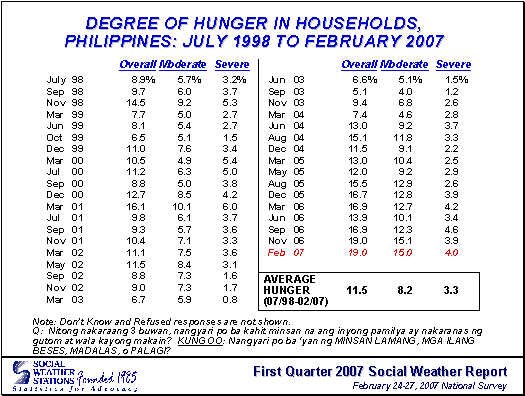 I think SWS and the media are ALL WET on their interpretation of these hunger statistics. Here is why...
Every three months since July, 1998, the Social Weather Stations public opinion pollster conducts a "self-reported hunger survey" among Filipino heads of households in which it asks the following question:
Nitong nakaraang 3 buwan, nangyari po ba kahit minsan na ang inyong pamilya ay nakaranas ng gutom at wala kayong makain? Kung OO: Nangyari po ba yan nang MINSAN LAMANG, MGA ILANG BESES, MADALAS O PALAGI? [During the last three months, has it happened even once that your family experienced hunger and you had nothing to eat? If YES, did that happen only once, several times, often or all the time?]The Table above is taken from the SWS Website and contains all the raw data from July 1998 to February 2007. Below I've prepared a chart based on the Severe Hunger data column and the Total Hunger data column from this Table.

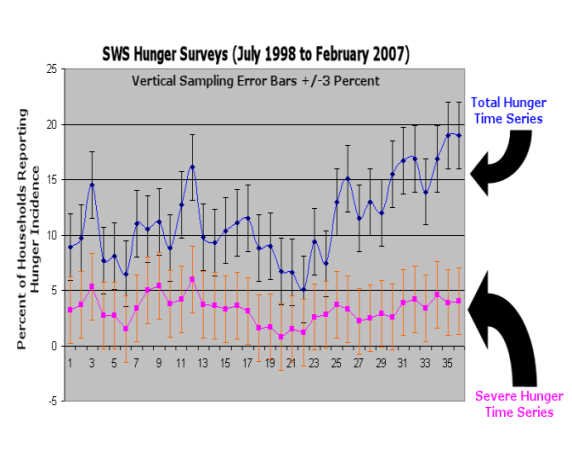
The Severe Hunger incidence is shown in hot pink with orange vertical sampling error bars of +/- 3 percent, while the blue time series represents the sum of severe, moderate and occasional hunger incidence reported by the 1200 randomly sampled respondents (all heads of households).
Inspection of these charts (click on them to zoom) leads to several simple and direct conclusions:
(1) Within the sampling error margins of + or - 3 percent for the data, the incidence of SEVERE HUNGER (often or always) has been CONSTANT throughout the entire survey period of almost ten years -- (in fact a trend line in Excel shows a slight decrease!).
(2) The TOTAL HUNGER data shows an apparent upward trend, but the following suggestive features are visible by inspection (as opposed to Fourier or other fancy analysis):
(a) There is a definite PERIODIC or CYCLIC component to the data on hunger incidence which shows local maxima (peaks) in each of the four election years during the survey period (1998, 2001, 2004 and if the trend continues through this year, in 2007 also).
(b) These maxima seem to occur in the quarter immediately preceeding Christmas season during the years 1998, 2001 and 2004.
(c) The upward trend as well as these seasonal variations (before Christmas in election years) cannot be attributed to the SEVERE HUNGER incidence because as we have noted, that data is CONSTANT within the sampling error margins.
(d) Thus all the variations in the data are due to self-reported "occasional" or "moderate" hunger incidence. That may be an effect of election and Christmas time attitudes of the population, i.e., they expect politicians to help them and so they report more hunger or need during these periods.
"There are three kinds of lies: LIES, DAMNED LIES, and STATISTICS"... (Ben Disraeli or Mark Twain)
No doubt there is persistent severe hunger in the country at around 3 to 4% incidence. But I cannot think of a better example from the third category above than the spin and propaganda based on these self-reported statistics on hunger in the Philippines which are foisted on a gullible public every three months by SWS, the mass media and anti-government pundits. They ever-ready to turn self-proclaimed "scientific" survey findings into screaming headlines and ditzy talk show comments, as I heard from Korina Sanchez this week on this matter. Frequently, what the media reports as "changes" or "record levels" of hunger, are actually random statistical variations that are produced seasonal variation and other factors that have no direct or even contrary connection with those phenomena.
Now don't get me wrong, when the SWS conducts surveys whose results will actually be confirmed or contradicted by subsequent objective events--like the voter preference surveys-- can generally be relied upon to be valid as their own historical record proves. But when it conducts surveys that can never be validated or invalidated by some independent or objective event like an election, the results have little statistical or scientific merit.
It is a little-known and vastly under-appreciated fact that not all SURVEY QUESTIONS are valid statistical survey questions! Not all survey questions are "good" survey questions, so that if you ask a "bad" or logically flawed survey question, the results will be of questionable validity even if you use exactly the same thoroughly scientific method to gather and analyze the data. For example, the SWS uses the same random sampling techniques and questionnaire presentation methods to gather data for voter preference surveys and the self-rated hunger surveys. Likewise they use the same mathematical and statistical algorithms to analyze those results. But it's really garbage in, garbage out if the survey question being asked is an invalid or "bad" survey question. It's a little like a technically competent violinist playing the same piece of music on a properly tuned Stradivarius as opposed to his shoestrings.
But what makes for a good or a bad survey question for the purposes of conducting a valid survey after assuming that the data collection and data analysis portions are done by the same completely honest and competent pollster?
The answer can be seen in contrast with the "good" survey question that SWS asks in voter preference polls. When they ask, which President or senators you would vote for if the election were held today, all the respondents probably understand the meaning of the question in pretty much the same way. The meaning of the question is definite and the choice of answers is really quite limited. However, "hunger" can mean many things to different people, and even different things to the same person at different times and seasons. And "not having any food to eat" does not mean that they could not get food if they really wanted to. Also, since the Catholics and Muslims obey religious food customs at Lent and Ramadan, these could be a source of the odd periodicity and cyclic behavior of the time series data. There are other factors at play here than what the usual suspects in media and punditocracy take to wringing their hands over.
Again, this is not to deny the constancy of the severe hunger incidence, but it should provide, uhmm FOOD FOR THOUGHT about the claim that ONE in FIVE or 18 MILLION Filipinos are starving or going hungry for lack of food and that hunger is at RECORD LEVELS. It certainly is not for the severely deprived and hungry, and hyping the data might not really help them if we act upon false premises due to wrong interpretations.
To me, these conclusions are not supported by SWS's own raw data and are merely the statistical variations to be expected from the random sampling errors and other more interesting reasons, like elections and Christmas.
Moreover, the self-reported hunger and poverty surveys of SWS are NOT, strictly speaking, on the same level of scientific quality as the voter preference surveys, for the simple reason that there is no independent, objective process to confirm or validate the results. This is what lends the hunger and poverty surveys to propagandistic or ideological spin, since all that is left is the hunt for reasons as to why there is so much hunger. Yet we are forced to the conclusion that there may not be as much hunger as we think at all, just a lot of pollsters and media folks HUNGRY for sensational headlines!
Thursday, March 22, 2007
Supreme Court Orders Continued Detention of Satur Ocampo
 The Supreme Court has ordered the continued detention at the Manila Police Dept. of the arrested multiple murder suspect Satur Ocampo (Congress representative of the leftist Bayan Muna party list organization) as it postponed oral arguments on his pleading for a Temporary Restraining Order (TRO) to March 28. The multiple charges against Satur Ocampo and 52 others, including Jose Maria Sison, stemmed from the discovery of a mass grave in Inopacan, Leyte last year and the testimonies made by former rebels who survived the purges. Lawyer Alan Paguia has the legal analysis for Philippine Commentary, including some interesting comments on the matter "amnesty" which Mr. Ocampo's "human rights" supporters (like the National Union of Journalists of the Philippines) in the Mass Media and the Punditocracy may wish to take note of with the chagrin and disappointment that they had coming... (via email)--
1. Why did the counsels expose Satur Ocampo to arrest before the SC could act on their petition for a TRO? This was their basic error. They knew the PNP would surely arrest Satur Ocampo because their duty to arrest in view of the judicial warrant was purely MINISTERIAL in nature.Related post at Philippine Commentary is The Killing Fields Come to Haunt the Killers.
2. Satur Ocampo's argument, to the effect that he had an "arrangement" with Sec. Puno, or some other high officials, does not hold any water. The duty of the executive officials to enforce the judicial warrant, being ministerial in nature, they had absolutely NO DISCRETION to deviate from the established procedure of promptly presenting Satur Ocampo before the Trial Court that issued the warrant. The error of the argument lies in their failure to distinguish between (a) a MINISTERIAL, from (b) a DISCRETIONARY DUTY. In effect, they were insisting that the ministerial officers exercise legal discretion which the latter do not have.
3. The proof of Satur Ocampo's error consists of: (a) the SC's refusal to issue a TRO, and (b) the defense counsel's act of going to the Trial Court AFTER Satur Ocampo's arrest. If there was no error, the SC would have most likely issued the requested TRO, in which case there would have been no need for Satur Ocampo's counsel to rush to the Trial Court.
4. Did the RTC judge act in accordance with law when he granted Satur Ocampo's urgent motion to stop the immediate transfer of the custody over his person from the Manila police to the Hilongos RTC? No. Reasons:
a) The act was done without giving the prosecution (People of the Philippines) an opportunity to be heard or to object. Therefore, the prosecution was deprived of its right to due process.
b) The physical presence of Satur Ocampo before the SC for the hearing set on Friday is not absolutely necessary under the Rules of Court. Why? First, the SC resolution which set Satur Ocampo's petition for hearing on Friday does not require his attendance. His lawyer's appearance is sufficient. Whatever arguments Satur Ocampo may raise personally can be better expressed by his lawyers. Second, the petition is NOT for habeas corpus where the petitioner's body is required to be presented in court. Thiird Satur Ocampo is already under arrest. His being in jail is a matter of due course. To give him the privilege of personally attending the hearing of his petition before the SC would constitute preferential or discriminatory treatment which is anathema to the Equal Protection Clause under the Constitution. Other prisoners who are similarly situated are not given that privilege.
c) The fact that the SC did not grant any TRO against Satur Ocampo's arrest ought to have been taken by the Trial Court as a clearance for it to exercise its jurisdiction over (a) the person of Satur Ocampo, and (b) the criminal case - in accordance with its own discretion.
5. Did Satur Ocampo invoke any amnesty in his petition? It does not seem so. The matter of the amnesty was raised in media by Joker Arroyo.
6. Amnesty is a matter of defense which must be invoked by the accused in the criminal case. Therefore, Satur Ocampo should raise the defense of amnesty before the Trial Court, not before the SC.
7. Amnesty applies to political offenses or crimes committed in furtherance of the political offense of rebellion or treason. Is the crime of murder such a political offense? No. Homicide may be. But not murder.
8. Did Satur Ocampo apply for amnesty under President Aquino's term? If he did, he is deemed to have confessed guilt for the crimes covered by the amnesty. If he did not, then he cannot invoke amnesty as a defense in the criminal case.
Tuesday, March 20, 2007
Filipino-American Commentaries on War and Peace
 NTIWAR sentiments are rising in America. Writing from San Francisco, California for the Philippine News weekly broadsheet, Filipino-American community leader Rodel E. Rodis (who is also an elected official of San Francisco City College School Board), pens an essay on the fourth anniversary of the war in Iraq. He is an old friend and a powerful voice that is often heard at Philippine Commentary, with due respect (and the unavoidable caveats from Michelle Malkin below...)
FOUR YEARS OF SCHOCK AND AWEMICHELLE MALKIN neoconservative Filipino-American blogger and online reporter, has an entirely different perspective in The Gathering of Eagles (courtesy of YouTube)
By Rodel E. Rodis
San Francisco, California
March 19, 2007
This week’s 4th anniversary of America’s “shock and awe” invasion of Iraq brought back memories of a family discussion four years ago about whether to join an anti-war rally to protest the impending war. Our three young sons told us that they had already been discussing the war in school all week and that everyone was opposed to it. “Of course we’ll all go,” they said.
So off we went the next morning to join the massive February 16, 2003 anti-war rally at the Civic Center in San Francisco. Police officials estimated that 200,000 people marched and participated in the rally to denounce President George W. Bush’s plans to invade Iraq. Whole families just like us were there to show their opposition to the war, with babies in strollers, and old folks leaning on their canes.
When my father-in-law, Romulo Austria, learned that we had attended the rally, he was upset. “Why didn’t you tell me? I would have joined you,” he said. This proud man, who was a young guerilla during the war against the Japanese, who enrolled in the Philippine Military Academy (PMA) after the war (class of ’51), who obtained a PhD in Engineering at the University of Rome in 1958, who worked for Bechtel as a nuclear engineer, and who had been a Republican, was early on dead set against the war.
“Bush is crazy,” he would tell his tennis buddies. “It’s a lie. There are no weapons of mass destruction in Iraq. Bush is just using this excuse to fool the people,” he said with firm conviction.
“Papa”, as I call him, turns 80 this week on Thursday, still firm in his conviction now as he was back then that the war in Iraq was and is a tragic mistake.
If Bush had listened to my father-in-law back then, more than 3,200 American soldiers and more than 150,000 Iraqis would likely still be alive today. We would not have close to 30,000 American soldiers in veteran’s hospitals like Walter Reed struggling to survive their war injuries. And we would have more than $600 billion to spend on education, health care and decent housing for the American people. And there would be money to fully fund the Filipino Veterans Equity Bill.
But why should Bush have listened to my father-in-law when he wouldn’t even listen to his own father? In his book, "A World Transformed," which was published in 1998 which he coauthored with his national security adviser, Brent Scowcroft, former President George H. Bush wrote that if he had pursued the retreating Iraqi Army back to Baghdad in 1991, the United States "would have been forced to occupy Baghdad and, in effect, rule Iraq." That would have collapsed the international coalition and alienated the Arab members to desert the coalition. “There was no viable 'exit strategy'... violating another of our principles," they wrote.
"Furthermore," they added, “[had] we gone the invasion route, the United States could conceivably still be an occupying power in a bitterly hostile land. It would have been a dramatically different -- and perhaps barren -- outcome."
In an article published in the Wall Street Journal on August 15, 2002 (7 months before the invasion), Scowcroft expounded on this point by asserting that an invasion of Iraq "was certain to divert us for some indefinite period from our war on terrorism. Worse, there is a virtual consensus in the world against an attack." Invasion of Iraq would require the United States "to pursue a virtual go-it- alone strategy against Iraq, making any military operations correspondingly more difficult and expensive ... [and] very likely would have to be followed by a large-scale, long-term military occupation." Such actions would result in a "degradation" of international cooperation, and an "explosion of outrage against us" especially in the Muslim world. Such a policy "could even swell the ranks of terrorists."
These points seem so obvious now in 20-20 hindsight but they were obvious to my kids and to my father-in-law even back then.
When asked why he didn’t listen to the advice of his father and his father’s national security adviser, Bush told Washington Post reporter Bob Woodward that it’s because he listens to a “higher Father”. So that was his reason. Bush claimed that God told him to invade Iraq probably just as Allah told Osama bin Laden to destroy the World Trade Center.
Both Bush and binLaden are basically religious fundamentalists, who both believe they are doing God’s will in what they do, that God is always on their side. But God commanded “Thou shalt not kill.” For Christian or Muslim fundamentalists, God’s commandments do not apply to non-believers or infidels. "Imagine there's no religion," John Lennon once mused.
Religious zealots are basically all that Bush has left in the US to support his failed Iraq policy. The latest polls show Bush’s popularity rating at 29%, one of the lowest ever for any US president. Even Donald Trump has come out publicly to declare that Bush is the worst US president ever.
At the February 16, 2003 anti-war rally we attended, there were many other Filipinos, a fact which the San Francisco Chronicle noted in its front-page coverage of the rally. “In the 400,000-strong (Bay Area) Filipino community,” the Chronicle reported, “many have friends or family members working in the Middle East as maids and construction workers, said Rhonda Ramiro, a San Francisco resident. An estimated 1.5 million Filipinos are employed in such jobs there.”
“Several of those marching with her and the 150 members of Filipinos for Global Justice Not War were airport screeners, laid off last fall in the wake of a new federal act requiring screeners to be U.S. citizens. "The younger people here know that their schools are bad already and will get worse if there's more money going for the military," Ramiro said."
At that anti-war rally, one of my sons bought a colorful “No Blood for Oil” t-shirt which he proudly wore in school the following week, prompting discussions about what the real reason for the Iraq war may be.
In this past week, The Washington Post reported that President Bush has asked the Iraqi Parliament, as a “benchmark” for measuring Iraqi progress, to pass the Iraqi Oil Law that would allow US multinational oil companies to take over Iraqi oil (“Whose Oil is it Anyway?,” Antonia Juhasz). It turns out my son’s t-shirt was right on the mark.
“They hate us because we value freedom” Bush has said time and again. Just exactly what freedoms are valued by Bush and Vice-President Dick Cheney? One of them is surely this. Halliburton (Cheney’s old company and the US corporation that has profited the most from the Iraq War through its no-bid contracts) enjoys the freedom to move its operations just this week from Houston, Texas to Dhubai. Doesn't it warm the cockles of Cheney's heart to know that more than 3200 American soldiers gave up their lives for this valuable freedom?
Happy 80th birthday, Papa, may you yet outlive this terrible war.
Feels kinda like the Sixties. Now the campaign for the soul of America in the elections of 2008 is well underway...
Monday, March 19, 2007
Manila Times Publishes Jose Maria Sison
The Manila Times carries this quite revealing piece by Jose Maria Sison replying to mulitple murder charges filed against him by the Philippine government following the discovery of a mass grave in Inopacan, Leyte. .
False charges of murder and robbery are mere propaganda rubbish from Arroyo regime
False charges of murder and robbery
are mere propaganda rubbish from Arroyo regime
By Prof. Jose Maria Sison , Chief political consultant National Democratic Front
So long as the Arroyo regime remains in power, there will be a constant flow of false charges of murder and robbery against me, whenever the New People’s Army inflicts death casualties and seizes arms and other military equipment in tactical offensives against the military and police forces in the Philippines.
Hundreds of such complaints have been filed against me by the Philippine military and police before government prosecutors and judges. These complaints amount to nothing but propaganda rubbish from the desperately isolated and brutal Arroyo regime. Quite a number of these cases have been either outrightly dismissed or archived by the relatively more sensible prosecutors and judges, with or without the representation of my lawyers, because of the sheer lack of evidence and the lack of jurisdiction over my person.
The recent internationally reported charge of multiple murder in Leyte against Bayan Muna Rep. Satur Ocampo, myself and 52 others and the more recent charge of murder and robbery in Masbate are part of the hundreds of false charges made against me.
Under the direction of National Security Adviser Norberto Gonzales, the Interagency Legal Action Group is under orders to complete 1,500 false charges against me before the end of the May 2007 election. What a waste of public money for producing propaganda trash!
The latest move of the Philippine National Police (PNP) is to propagandize its supposed request to the International Criminal Police Commission/Organization (Interpol) to issue “red notices” to seek the arrest of myself and the NDFP negotiating panel chairman Luis Jalandoni for the purpose of extradition to the Philippines on the basis of a valid judicial warrant. But there is no extradition treaty between the Netherlands and the Philippines!
I am used to false charges that come and go. These are cheaply fabricated by the Manila government. Remember that the 1998 charge of subversion against me was nullified by the repeal of the Antisubversion Law in 1992 and that the 1991 charge of multiple murder against me was dismissed by the Manila prosecutors in 1994 as something based on sheer speculation. In 1998 the secretary of justice of the Ramos government certified that there was no pending criminal charge against me. But since 2003 the Arroyo regime has the practice of fabricating false charges against me.
On my part, I am not at all worried by the false charges being made against me by the military and police minions of the Arroyo regime. I laugh off all of them. Below are the strong factual and legal grounds for my confidence.
First, the charges are so patently false, malicious and politically motivated.
Second, the whole world knows that the leadership of the Communist Party of the Philippines and the command of the NPA are in the Philippines and not in the Netherlands.
Third, I am protected by Article 3 and entirety of the European Convention on Human Rights and Refugee Convention.
Fourth, there is no extradition treaty between the Dutch and Philippine governments.
Fifth, under Philippine law itself, I am outside of the custody and jurisdiction of the Philippine government and cannot be arraigned and tried on any charge.
The Arroyo regime is trying to show off that it can put down its Filipino critics anywhere in the world. But it only succeeds in exposing its callous intolerance for my exercise of the freedom of speech and its contempt for fundamental democratic rights. It has ignored the findings and conclusions of fact-finding missions by human-rights organizations, international civic organizations, religious organizations and the UN special rapporteurs on various aspects of human rights.
The Arroyo regime is intensifying its campaign of vilification against me in a futile attempt to counter the impending Permanent People’s Tribunal in The Hague, Netherlands, from March 21 to 25, which shall try the case of the Filipino people against the Arroyo regime and its imperialist accomplices headed by the US, on the three major charges of human-rights violations, economic plunder and transgression of Philippine national sovereignty. The case has been filed by families of the victims of human-rights violations, human-rights organizations, Bayan and the Ecumenical Bishops’ Forum, among others.
Sunday, March 18, 2007
Alan Paguia Comments On Satur Ocampo's Arrest
 This is a text message from lawyer Alan Paguia:
Warrant vs Satur was issued by Leyte Regional Trial Court either (a) with jurisdiction; or (b) without jurisdiction. If (a) then Satur's petition for certiorari before Supreme Court will be dismissed. If (b), the proper remedy would be a motion to quash the information before the Regional Trial Court, not certiorari before the Supreme Court. Also if (b), surrender is not proper because RTC acted without jurisdiction,. Temporary Restraining Order would be proper to restrain arrest. When Satur got himself arrested, his petition for TRo became moot and academic. There is nothing more to restrain. Therefore Satur's counsels erred when they exposed him to arrest before obtaining a TRO.I have no doubt that my good friend Alan Paguia is right about this. But I am also certain that a great big political ruckus will arise and be thoroughly exploited by the Left even if these multiple murder charges being filed against over fifty top communist leaders allegedly involved in The Killing Fields of Inopacan can't be given the adjective "extrajudicial". It is a stunning thing that there seems to be more concern over the "oppression" of the self-declared "revolutionary government" in Utrecht and its local allies than justice for the alleged victims of their paranoiac purges of the eighties, whose skeletal remains have only come to light after all these years. I know they are dead now, but whatever happened to their "human rights"? Where are all the liberal bleeding hearts? (Oh, that must be them rallying and scuffling with the police who arrested a man charged with multiple murder, or mugging the TV cameras discussing his blood pressure and demanding the Law let bygones be bygones!). As for the Dutch, they really are the biggest state sponsors of terrorism in the Philippines. I am definitely attending the La Naval de Manila celebrations this year. Viva Espana!
Saturday, March 17, 2007
Commentaries on Terrorism, the Left and the Jihad
I've been spending the last few days over at Manuel L. Quezon III's blog discussing these issues with a lively Comment Thread. A selection of the more interesting contributions follows.
MLQ3:
MARVIN ACERON:
DJB:
MARVIN ACERON:
MLQ3:
The point here is that when corruption enters the picture, then the very things that should serve as safeguards -the law, legal procedures, etc.- become viewed as a means to ensuring that the law becomes yet another tool to protect the mighty and disadvantage the weak. This is at the heart of disagreements between people like myself who oppose the Anti-Terror Law, and its supporters like Philippine Commentary.DJB:
The terrorist tag is an awesome label, not least because no one would proclaim himself publicly to be a terrorist, except from within the caves of ToraBora (but not YouTube). It’s the same with communists, as even Joma bills himself largely as a “professor” or a “political consultant to the NDF peace panel.MLQ3:It is for that reason that both US and EU anti-terror laws maintain official LISTS of foreign terrorist organizations and individuals that are annually reviewed by the government and legislatures as virtual extensions of the law.
So it is wrong to think that the Human Security Act can just arbitrarily designate anybody a terrorist, even though reading its rather general (and in my opinion limited and weak) definition of “terrorism” has attracted various forms of argumentum ad absurdum from lawyers like Nery Colmenares, who seems to already be preparing for a legal defense of his comrades in the various front organizations.
But let us not forget that the law still has to develop Implementing Rules and Regulations where the battle to refine and rationalize the law must continue for civil libertarians and democrats. I believe that the IRR’s should address the criticism of possible arbitrary application of the terrorist tag by mandating such open, annually approved and reviewed LISTS of who the terrorists are officially considered to be. Our first list ought to include the current lists of our allies because there is no question that terrorism recognizes no boundaries and claims no territories. Terrorism is an international network that spans the globe from Utrecht to Manila in both hemispheric directions.
Now as you know, the definition of terrorism that I prefer is my own: TERRORISM is organized crime to achieve the political and ideological end of overthrowing the legitimate government by illegitimate means.
That certainly makes terrorists out of organizations of revolutionaries, insurgents and rebels who use violence, drugs, extortion and other criminal activities to achieve their goals. So be it. They can remove the label from themselves if they win. (And before I get the usual argumentum ad absurdum comments from the thread: YES to the British, George Washington was a terrorist!) If a group gets put on a list and the Court of Appeals and the Supreme Court approves it, then the law can operate in the full light of regularity.
I think the key objective of the Law is to encourage all political dissent to be within its fold and for all violent and illegal means of struggle to be shunned and condemned by all, in word and in deed.
I believe that HSA 2007 is necessary because such “encouragement” is no longer enough in the face two specific terrorist instantiations: religious jihadists and secular insurgents, who either deny their true objectives and natures or hypocritically participate in peaceful parliamentary struggle but secretly support violence or justify its use by others.
In the case or Bayan Muna, Gabriela and other orgs accused or suspected of being associated with those forces that our allies have already labelled as terrorists, it would be a simple matter to renounce the violent and illegal activities of those forces to innoculate themselves against the tag, instead of a bunch of guilty sounding gobbledygook refusing to do so for obscure and tendentious reasons.
Why is it so important to denounce and renounce the NPA and its violent insurgency? Because it is precisely the accusation that they are providing ideological and political support for the military wing that resonates with so many people which they ought squarely to face and prove to be wrong. They keep saying that as long as they don’t actually bear arms and use them they cannot be accused of supporting the violence and extortions. In that, they insult our intelligence. In that they have no credibility with the people.
In this, they are not being asked to prove their innocence, but their honesty and allegiance to the Constitution and to the God who saves it, so that we would come to support their causes and objectives too, which are noble sounding. It is their hypocrisy that most people detect and which prevents them from winning genuine popular support. It is their guilt-ridden disingenuity that is the source of their historic failure to rally the masses to their red flag.
djb, i have a problem with asking elected officials to prove their loyalty to the constitution. they took an oath to do so. neither you nor i have been asked to do that. and if you want to go down the path of rule of law, then we should presume they are true to their word. if we doubt them, then charges can be filed, and in the cases filed against satur ocampo, i’ve said let him vindicate himself in court.
We cannot compel anyone to prove their allegiance to the Constitution. But where large numbers of otherwise well meaning citizens come to doubt the allegiance of certain groups and individuals to the Constitution because they once took up arms against it, or get shifty eyed and mumble mumbo jumbo when politely asked if they support the NPA, it sure would help if they would just give a straight answer, as we often see Ricky Carandang, Pia Hontiveros, and the rest of our friends at ABSCBN do on tv all the time. Surely, we do have a right to ask, no? Or is not somehow politically correct to ask politicians and public officials where they stand just because they call themselves leftists? We do it all the time to other politicians and public officials. What makes Satur or the other partylist folks so special? What makes them so touchy about this that we can’t get a simple declaration from them about the NPA and its violent activities. Why do we just get a bunch of oblique or downright evasive answers.If you ask Satur, “Do you support the NPA?” why doesn’t he say YES or NO?
If he says NO, he gets to go on with his life (unless of course you believe the CPP NPA is into extrajudicial killings of ex-comrades and rejectionists, which he himself denies.) If he says YES, then the politically correct can no longer give him the benefit of the doubt.
The fact he has never said NO only proves that his real answer is YES, by the inescapable iron logic of personal and political survival.
His silence, which of course is his right, nonetheless means it is highly likely that the answer is YES.
“TERRORISM is organized crime to achieve the political and ideological end of overthrowing the legitimate government by illegitimate means. –DJB”This is the kind of definition that is not only all-encompassing, but is downright ABSURD. If we go by this definition, Cory Aquino, Juan Ponce Enrile, Gloria Arroyo, Mike Arroyo and all those who supported EDSA 1 ans EDSA 2 are terrorists because they plotted to overthrow the existing legitimate governments. Certainly both EDSA 1 and 2 only became legit AFTER THE FACT, when the terrorist Supreme Court validated what could have been illegitimate means in the overthrow of Marcos and Estrada.
Thanks to DJB, even Bush is a terrorist (and I agree!) because they illegally invaded Iraq who had a recognized government at that time and made the international community believe that Saddam hid WMD.
MARVIN ACERON:
It’s hard to get a conviction under the Anti-Terrorism Law. The court room would be a favorable battleground for those who oppose it.
DJB:
Could you give a critique of that definition from a legal standpoint? The RICO statutes I believe give a pretty good definition of ORGANIZED CRIME as it applies to syndicates like the Mafia, whose goals are of course economic and financial power. In addition the term itself has colloquial public meaning (ie most people “know” what one is referring to whenever the termis used in most contexts). I have adopted it to apply to organized criminal syndicates whose power goals are political and ideological in nature.But how would you improve it if you were tasked with amending the current law and the definition of terrorism therein, which I really don’t like because I don’t think “striking fear or panic” in the public is the essential goal of real terrorists. IN the case of the jihadists and the communists, I think it is the outright destruction of civilization as we know it and the establishment of a caliphate-theocracy or a totalitarian dictatorship, respectively.
Terrorists are not “demanding” the establishment of these alternative orders, they are seeking to actually bring them about by violently and utterly destroying the existing order, with or without our consent.
MARVIN ACERON:
This link takes you to my first post on the Anti-Terrorism Law. In the last portion of the entry, I broke down the elements of the legal definition of Terrorism as follows:1. Violation of any of penal law enumerated (rebellion, murder, etc.)
2. Sowing and creating a condition of widespread and extraordinary fear and panic among the populace
3. For the purpose of coercing the government to give in to an unlawful demand.Mr problem is how do you prove “widespread and extraordinary fear and panic among the populace” in court? A lot of isolated terrorist attacks particularly those in the rural areas are not going to qualify under this definition.
Then you have the last element which is coercing the government to give in to an “unlawdul demand”. The term “unlawful” is going to give the prosecutors another headache. What happens if somebody bombs the Ombudsman for sitting on graft cases? That appears to be a lawful demand, but I think that should be terrorism too. Further, what if somebody bombs the LRT but the purpose of the attack is not disclosed to the public like the Rizal day bombings of 1999? Then the last element is not going to be met.
Elements 2 and 3 are subjective matters. That’s why prosecutors, public attorneys, human rights activists, and judges are going to spend a lot of time arguing over this definition. And given that our court system is slow, even for simple BP 22 cases, I bet we will wait ten years before the first conviction is made.
Thursday, March 15, 2007
Argumentum Espositus: Anti-Terror Law Will Cause Terrorism
 illy Esposo of the Philippine Star produces a real gem today. I've been waiting for one of the usual sources to advance this particular fallacious line of reasoning in order to criticize the newly passed Human Security Act of 2007 (the Anti-Terrorism Law), which he calls the product of PUNY MINDS--
What if the Reds resort to terrorism? by William Esposo: "Now wielding its anti-terror bill, it is determined to finally tag the NDF-CPP-NPA (National Democratic Front-Communist Party of the Philippines-New People’s Army) as a terror group. This is again the product of puny minds that just can’t see the bigger picture and the far bigger complications. Supposing they succeed in declaring the NDF-CPP-NPA as a terror group, what will these organizations stand to lose if they now decide to operate as terrorists? Have any of the regime’s bright boys thought about how that dreadful scenario can impact on the economy, much less the peace and order situation?Mr. Billy Esposo must be very proud of his huge and expansive mind for having thought this up. But the rest of us, who only have puny minds with which to apprehend reality may find his premises a bit difficult to comprehend. Is it not already a terrorism when the CPP NPA goes around with gun-toting thugs and remote control land mines demanding "revolutionary taxes" from ordinary citizens, business enterprises and local government units?
The Reds are smart operators and will likely avoid hitting civilians in the crossfire. But what if they start bombing establishments all over Metro Manila as the failed December 1989 coup plotters had done in 1990 and 1991 against the government of Cory Aquino? Did a GMA bright boy figure out what that will do to Arroyo’s fragile economy?
Supposing that, for good measure, the new terror group decides to start hitting official targets like generals, government agency heads and unpopular local cops like what the Sparrow Units of the late 1980s did? How does that make Madame Arroyo look to the nation and the international community? What happens to the drive to attract foreign investors? "
With such a towering genius as Billy Esposo, it is apparently not yet terrorism when the NPA burns down three small public school buildings in the hinterlands because the local superintendent refused to yield to their extortion demand for 300,000 pesos, or else. I guess he would call that "Revolutionary Public Education"?
How would Mr. Big Brain Billy Esposo describe the presence of drug labs in CPP NPA infested areas? Puny minds want to know! Public Health Medical Missions?
When the New People's Army attacks cell phone transceiver stations it perhaps does not occur to the cerebral Mr. Esposo what a tremendous loss it is for the most ordinary people who've come to rely on wireless communications in the rural and urban areas ill served by landlines and telephones. You see, with nearly 50% of the population owning cell phones, even small vendors, professionals, farmers, and small businesses have come to rely on the wireless cellphone network for all their communication needs. Unfortunately, the NPA knows how lucrative the telecommunications business has become, and so a large amount of their extortion income actually comes from one phone company --(PLDT/Smart)-- which almost never gets bombed by the terrorist rebels, who appear to concentrate their regular bombing runs on rival Globe telecomm cell sites to demonstrate what happens to recalcitrant capitalists that don't give in to terrorist demands.
Critical infrastructure, like electric power transmission towers, is often attacked by both communist insurgents and Islamist rebels with no thought for the damage done to the lives of the poor and disenfranchised that they nobly claim to be fighting for.
And what does the Cerebral Billy E. call it when political parties and candidates for public office receive from shadowy messengers "application forms" for permits to campaign with expensive application fees during election season? When they assassinate government officials or their ideological rivals, when they raid police stations and "confiscate" arms and ammunition in order to sustain their violent armed struggle, does he not think those are terrorist acts?
I think Billy Esposo needs to have his big head examined. Following his logic, we may as well repeal the laws against murder and robbery as these apparently are the real reasons we have so many murderers and thieves in government. Why even enact laws against graft and corruption, when such a big, brilliant mind as Billy Esposo's informs us that the reason the Philippines is the corruption capital of Asia is probably because we've made it ILLEGAL to engage in graft and corruption?
With such a scintillating mental giant as Billy Esposo, why do we need Senators and Congressmen, Presidents and Generals? After all, he claims they've passed their own death sentences for passing a law that will cause the CPP NPA to feel so insulted and oppressed at being called terrorists that they will indeed engage in their old-style Sparrow Unit assassination pogroms against these terrible class enemies of the people. Now of course, since there was no terrorist label back then, I wonder what caused them to engage in those assassinations, extortions, bombings and killing fields he speaks of? Or does it really matter WHAT they are called before they will engage in any means to establish a totalitarian dictatorship of the professoriat?
See, all we have is our puny mind and these silly questions for which Billy Esposo has all the answers. He thinks that by passing the Anti-terrrorism law we will drive away foreign investors. Oh slap me on my puny noggin for thinking that it was the 40 year old communist insurgency and graft and corruption that's been driving the investors away from this sad archipelago of puny minds. Only such a brain as Billy Esposo can perceive the "bigger complications" of the Human Security Act of 2007!
Of course, the Cerebral Billy assures us puny ones that even when [sic!] the CPP-NPA engages in even more horrific acts of terrorism, we really have nothing to fear as long as we don't side with the government and the military class enemies of the people because, "The Reds are smart operators and will likely avoid hitting civilians in the crossfire."
Speaking of terrorists here is the JoMa of Them of All caught on video gloating over the millions of members in hundreds of front organizations and naming all his comrades in the above ground "legal" parliamentary struggle.
But just in case the communist terrorists go on some kind of offensive, maybe what the people will do is similar to what these simple Filipinos did recently in La Trinidad, Mt. Province:
Unarmed Villagers Shield Outgunned Soldiers From Rebels (ABSCBN News)!
Except they WILL be armed with the Law!
Not until the law actually comes into effect in July will the organized criminal syndicates that perfume themselves with all sorts of noble-sounding other labels actually be called "terrorists" yet it is obvious even to puny minds that they are ALREADY engaged in terrorism.
So to his humongous argument espositus let the puny minds exclaim: Nego supositum!
Wednesday, March 14, 2007
FYI: The True Uncertainty in the Net Satisfaction Rating
 fter about twenty years of being exposed to the public opinion polls, both the Media and Public have, if only dimly, come to understand that there is a built in UNCERTAINTY to every statistic reported by the scientific pollsters like SWS and Pulse Asia. This uncertainty is sometimes called the MARGIN OF ERROR or the SAMPLING ERROR because it arises from the fact that every survey picks a finite random sample of the overall population, asks them the survey question and then PROJECTS the result to the entire population. The margin of error is the price we pay for surveying a small subset and then making a generalization that can become a screaming headline about the total population.
Typically, SWS and Pulse Asia use a random sample size of 1200 respondents. Now, get a nice calculator and compute the the reciprocal of the square root of 1200 (Enter 1200, press the button [1/x] then the button [SQRT]) and you will get a result equal to 0.02886751 which approximately equal to plus or minus 2.89 percent or about plus or minus 3 percent. If you go to the website of SWS or Pulse Asia you will see that they report this number, plus or minus 3 percent as the "sampling error" in their national statistics. If you do the same thing for the regional sample size of 300 respondents, you will find that the reciprocal of the square root or 300 is plus or minus about 5.77%.
So far so good. But they do something clever when they ask respondents if they are satisfied or dissatisfied with the President. They take the DIFFERENCE of the two statistics by subtracting the percentage of those saying they are dissatisfied from those who say they are satisfied and they label the result the NET SATISFACTION RATING (NSR). For example today, SWS reports that 39% claim to be satisfied while 43% claim to be dissatisfied resulting in an NSR of negative 4 percent.
But it cannot be denied that the sampling error in each of the two statistics being combined by taking their difference is plus or minus 3%. In other words 39% plus or minus 3% are satisfied whilst 43% plus or minus 3% are dissatisfied. But it is WRONG to think that the Net Satisfaction Rating also has a plus or minus 3% margin of error, because it is fundamental to the statistical sciences that when you combine statistics that have sampling errors, you must ADD together the individual sampling errors to calculate the equivalent error or UNCERTAINTY in the computed result, like the NSR.
This means that the uncertainty in the NET SATISFACTION RATING is actually PLUS OR MINUS SIX PERCENT. That is the reason why SWS in its media release said that the apparent improvement in the President's NSR was "SLIGHT" even though it apparently changed from negative 13% last quarter to negative 4% this quarter! Technically, the improvement of 9 percentage points in the NSR is "slight" because it is bigger than the uncertainty of plus or minus 6% in the NSR, but only "slightly." However, the best way to describe this most recent poll result is that, at the level of confidence cited (95%) it is not possible to decide if President's NSR is positive or negative. But it cannot be denied that it HAS improved, at least slightly, from the last survey.
If you compare plots of the NSR over time with plots of just the Satisfaction rating or just the Dissatisfaction Rating, you will notice that the NSR is about twice as erratic as the latter two statistics when plotted in a time series. This is because the NSR is a really lousy, almost useless statistic at random sample sizes of 1200 respondents. The NSR is however a very a commerciable statistic and often makes BIG BOLD HEADLINES, especially among ignorant mass media outlets.
The other important point is that if you add 39% to 43% you get 82%. In other words 18% of the respondents were UNDECIDED, which is in fact, to my mind, the real magnitude of the uncertainty in the NSR. But they INVENTED the NSR precisely to avoid this rather embarrassing fact about their polling.
By the way, the formula that relates random sample size to sampling error -- "the reciprocal of the square root of the random sample size"-- is only approximate. It depends on the level of confidence you want to have in the result and would unfortunately take a major detour into combinatorial and statistical theory to derive mathematically. So you will just have to accept this formula on "faith" from me and the pollsters.
It is a key concept however in understanding surveys and learning how to properly interpret them. Sampling error or margin of error or statistical uncertainty is also the reason why the SWS says that 17 candidates still have a statistical chance of making it to the Magic 12 in the Senate race. I could nitpick this statement too, but let's save it for the next time...
MLQ3 has the latest analysis of the Senatorial race based on today's Pulse Asia, Inc. poll.
New to my blogroll is INEVITABLE KARMA, a blog from the Philippine Science High School. Here's a video from some of the students there (Pisay Meets The World--We Hold the Future):
ROCKIN' SCIENCE!
Tuesday, March 13, 2007
Constitutional Conservativism and Angara On Charter Change
 SENATOR EDGARDO ANGARA deserves to be re-elected to a Senate seat in the coming May elections because of his philosophically conservative stand on Charter Change during the next three years, which he cogently expressed during the ABSCBN News Forum 2007 debate on that crucial subject telecast Monday evening. By "philosophically conservative" I mean a position that seeks to reduce the size, intensity and nature of government's role in Philippine society which strongly reflects Thomas Jefferson's dictum that "The best government is the least government, because then the people must discipline themselves."
Angara summarized his position on what to change and what not to change, in several major points whilst replying to the panel of interrogators who asked a variety of questions to elicit the views of the three participating candidates (which also include House Minority Leader Francis Chiz Escudero of the Genuine Opposition and KBL's Oliver Lozano who both expressed essentially liberal, Big Government positions that I discuss only briefly at the end of this post).
ON WHAT NOT TO CHANGE Angara opposes the attempts of the Palace and its House allies to radically transform the current political system along the lines of a Unicameral Parliamentary or Unicameral Presidential system. I think he believes as many "natural" conservatives do that this is essentially a rearrangement of the deck chairs on the Titanic that only gives the politicians a new game to play that won't actually change the course of the Ship of State and only lead to a more expensive and powerful government, even if it makes elections a little cheaper. Moreover, as I've pointed out during the anti-chacha wars of 2006, such a switch to a unicameral parliament will deprive the people of their right to directly elect the national leaders and concentrate power in nationally unelectable back-room politicians like Jose de Venecia, Luis Villafuerte and Butch Pichay.
Next, on what changes he would advocate he mentioned three major reforms:
(1) LOCAL GOVT AUTONOMY Angara wants to push the issue of local government autonomy which is a key conservative position that essentially reduces the power of the national government. He did not expound on this very much but I think it would include an amendment to take away from the Palace its stranglehold on the government's finances, for example by ensuring that the Internal Revenue Allocations (IRA) go directly to local government units without being at the mercy of the Chief Executive, a form of centralized control that Gloria Macapagal Arroyo has raised to a grotesque art form. This goes to the heart of what is wrong with the Executive Dept. setup we now have under the 1987 Constitution and could lead to a fruitful federalism.
(2) REFORMING THE ACTIVIST JUDICIARY Angara wants to do something to rein in an essentially out-of-control and power-besotted Judiciary. In particular, the Supreme Court meddles in everything from the economy to politics to social issues. Its most despicable expression was seen in the judicial putsch of Hilario G. Davide during the 2001 Edsa Dos coup d'etat on the Presidency, when he abandoned the Senate Impeachment Trial of Joseph Estrada, and illegally and unconstitutionally swore in the Vice President. Throughout the last twenty years the Court has been involved in various interventions on business, the economy, and whatever suits the fancy of a bunch of unelected judges who've dispensed with the idea of impartiality as cold, neutral justices.
The Manila Times columnist Tony Lopez put it like this--
Another pernicious provision of the Cory Constitution is the power of judicial review of the Supreme Court and courts under it.I could not agree more!
“Judicial power includes the duty of the courts of justice to settle actual controversies involving rights which are legally demandable and enforceable, and to determine whether or not there has been a grave abuse of discretion amounting to lack or excess of jurisdiction on the part of any branch or instrumentality of the government,” says Article 8, Section 1 of the Cory Constitution.
Under the 1935 Constitution, the Supreme Court could only review the constitutionality or validity of any treaty, law, ordinance or executive order or regulation in question. It couldn’t rule on political questions. This enabled Ferdinand Marcos to impose his strong-man rule because martial law was a political question.
To remedy the situation, the Cory-handpicked framers of the 1987 invested courts with the power of judicial review or what is known as determination of “a grave abuse of discretion amounting to lack or excess of jurisdiction.” The result is that courts went beyond their jurisdiction and their competence.
This provision made the Supreme Court very powerful and resulted in what Chief Justice Reynato Puno himself has described wryly as the “judi-cialization of politics.” Conversely, in my view, it resulted in the “politicization of the judiciary.”
Judicial review also meant judicial interference in matters of purely business or economic interest. Thus, the Supreme Court could order the relocation of a Taiwanese petrochem plant from Bataan to Batangas or vice versa, nullify the bidding for the Manila Hotel and award it to a losing bidder in the name of national patrimony. It also got the high court enmeshed in a shipyard bidding and many other economic issues. And if we are not careful, the courts might just outlaw globalization one of these days.
This made justices and judges businessmen and entrepreneurs and even economists. It also made them politicians as well. It made the judiciary the strongest of the three branches of government. Note that it was the Supreme Court en banc, not People Power 2, that installed Gloria Arroyo as president in January 2001.
(3) ECONOMIC REFORMS Angara wants to concentrate on reforming the "economic provisions" of the 1987 charter which he says basically cast in concrete certain allegedly nationalistic and patriotic concepts regarding foreign ownership of land and business enterprises. His point is a subtle but reasonable one. He does not explicitly call for the abolition of these provisions and protectionist measures, but insists that the country ought not to have its hands tied. We ought to have the flexibility to adopt, adjust or abolish them according to the needs of the country and people via normal Congress legislation. He points out that all the countries in our region, including China, have learned how debilitating PROTECTIONISM actually is, saying that instead of 2.5 billion dollars in foreign investment here, we could achieve many multiples of that if we learn the same lesson.
Finally, when asked what mode of Charter Change he favors, Angara replied that he believes in charter changes essentially via Congress acting as Constituent Assembly, which is also how the United States with its bicameral Congress and federal state system, has done it during the last two hundred years and 27 Amendments to its own charter. I like this far better than the position taken by Chiz Escudero for a Constitutional Convention, which I believe would only lead to the liberal madness of radical, wholesale changes imbued with the delusion that we can solve our problems by designing a more perfect government (i.e., bigger, badder government). A Concon is equivalent to giving birth to the Nation, and really ought to be done but once in a nation's lifetime. We've done it at least four times already (1899 Malolos, 1935 Commonwealth, 1972 Marcos and 1987 Cory)! A fifth time can only result in another 80% solution with a different set of imperfections. A Constitutional Convention will always attempt to re-invent the wheel.
In contrast, Chiz Escudero and Oliver Lozano expressed classical liberal positions with a populist flavor that I consider to be mere pandering to the masses in the tv audience whilst upholding protectionism that benefits only the existing elites. As such they probably won the on-air debate forum. Their ideas were noble sounding, but unsound. Escudero's opposition to charter change on the basis of opposition to, and perhaps justifiable distrust of Gloria Macapagal Arroyo represents a poverty of Statesmanship. Meanwhile, I see a poverty of Logic in Oliver Lozano's sound bite that allowing foreign ownership of land will result in Filipinos being squatters in their own country. Ahem. But they ARE squatters in urban ghettoes now on land owned by Filipino elites and feudal lords that keep us from participating in and benefiting fully from globalism. I think Angara answers their objections to chacha by opposing the radical changes in political system and government structure that we saw in 2006 whilst offering a cogent intellectual challenge to the prevailing liberal, centralized Big Government philosophy in the form of greater local autonomy.
Angara did not make it to the Magic 12 in the Feburary SWS survey of the Senate race. Pity, but I hope even if he doesnt win that his ideas will.
Monday, March 12, 2007
The Killing Fields Come To Haunt The Killers
In August, 2006 local residents and former NPA rebels led government authorities to "The Garden" on an isolated ridge in barrio Kaulisihan, Inopacan town, Leyte province, where the skeletal remains of hundreds of victims of internal Communist Party purges from 1985 were dug up with the help of K-9 units and forensics experts. Former company commander of the NPA's Southern Leyte front committee, Zacarias Piedad, and platoon leader Leonardo Tanaid, testified before the media last September in Manila, that he personally saw the signed orders of CPP Chairman Jose Maria Sison, Central Committee member Satur Ocampo, and NDF spokesman Luis Jalandoni to rid the organization of government spies and infiltrators, who were then brought before an NPA kangaroo court then summarily knifed and hacked to death, then buried in "The Garden". It is one of the many "killing fields" that not even the CPP-NPA has been able to deny it created as a result of paranoia that the they had been penetrated by government agents and then engaged in bloody pogroms against suspected comrades, reportedly resulting in thousands killed and few if any spies found. In this report from Bulatlat, which often serves as the media outlet and apologist of the CPP-NPA, present-day Bayan Muna party list representative Satur Ocampo joins with a certain "Committee Defend" of the CPP Central Committee in Utrecht, the Netherlands in damage control over the discoveries in Leyte by claiming the mass grave is a fake. But now that Ocampo, Sison, Jalandoni and 50 other CPP NPA NDF leaders have been charged with rebellion and warrants of arrest for mass murder have been issued against them by a Regional Trial Court in Hilongos, Leyte, But even the Interpol may soon be after them. Other officials of the communist movement's aboveground front organizations may also be charged in connection with an ongoing investigation into extrajudicial killings by the CPP NPA in Bongabong, Nueva Ecija. Manila Standard columnist Emil Jurado reviews the "unreported atrocities" of the communist movement that has received scant attention from other mass media.
In today's PDI news headlines, National Security Adviser Norberto Gonzales said that the legal offensive against the CPP and its front organizations is intended to establish "...the legal parameters of the nation… that armed rebellion is no longer acceptable as a means of achieving political change.” But check out the newspaper's editorial which seems to be lawyering for the accused murderers, Ocampo and Sison, claiming the impossibility of "bilocation" since both were in jail at the time of the purges, as if the CPP isn't still directing the NPA and NDF's insurgency all the way from comfortable exile in the Netherlands. Following the lead of Ocampo's lawyer-comrades Romeo Capulong and Nery Colmenares, who last Friday called the filing of murder charges "hasty" (21 years after the alleged crimes were committed!) here comes Conrado de Quiros questioning the the charges even as he admits they are about murder most foul:
Speaking of which, I wonder how the Sharonians are gonna take Senator Kiko Pangilinan's knee-jerk reaction "strongly condemning" the government for taking clearly JUDICIAL steps to bring justice to the perpetrators of mass murder and mayhem.
Amando Doronila produces the other head-scratcher today with his claim that the attempt of the authorities to serve a Court Warrant of Arrest on Satur by raiding his home in Quezon City is "fascistic" and a throw-back to martial law days.
Well, maybe the US Senate and House hearings on extrajudicial killings in the Philippines would like to add this lil item to their agenda later this week, as Satur Ocampo tries to hide under Barbara Boxer's, uhmmm, shorts. (The news item above from the Philippine Star claims Satur has been invited to the US Senate hearings, but the Manila Bulletin has the authoritative coverage.
In today's PDI news headlines, National Security Adviser Norberto Gonzales said that the legal offensive against the CPP and its front organizations is intended to establish "...the legal parameters of the nation… that armed rebellion is no longer acceptable as a means of achieving political change.” But check out the newspaper's editorial which seems to be lawyering for the accused murderers, Ocampo and Sison, claiming the impossibility of "bilocation" since both were in jail at the time of the purges, as if the CPP isn't still directing the NPA and NDF's insurgency all the way from comfortable exile in the Netherlands. Following the lead of Ocampo's lawyer-comrades Romeo Capulong and Nery Colmenares, who last Friday called the filing of murder charges "hasty" (21 years after the alleged crimes were committed!) here comes Conrado de Quiros questioning the the charges even as he admits they are about murder most foul:
Having said that, I protest most vehemently the arrest warrant on Satur Ocampo. That is an abomination that has no right to exist in a country pretending to be a democracy. Indeed, in a country pretending to have elections. What’s wrong with it is everything. At the very least its timing sucks.Sucks for whom? The victims? The widows and surviving family members? Or for the fugitives and their allies?
Speaking of which, I wonder how the Sharonians are gonna take Senator Kiko Pangilinan's knee-jerk reaction "strongly condemning" the government for taking clearly JUDICIAL steps to bring justice to the perpetrators of mass murder and mayhem.
Amando Doronila produces the other head-scratcher today with his claim that the attempt of the authorities to serve a Court Warrant of Arrest on Satur by raiding his home in Quezon City is "fascistic" and a throw-back to martial law days.
Well, maybe the US Senate and House hearings on extrajudicial killings in the Philippines would like to add this lil item to their agenda later this week, as Satur Ocampo tries to hide under Barbara Boxer's, uhmmm, shorts. (The news item above from the Philippine Star claims Satur has been invited to the US Senate hearings, but the Manila Bulletin has the authoritative coverage.
Sunday, March 11, 2007
Rina Jimenez David on Patriotic Prostitution and Sovereign Rape
The Philippine Daily Innuendo's resident feminist blames the large number of prostitutes on the Visiting Forces Agreement (VFA) and the presence of US troops in the Philippines in her Sunday column Spin, Pimping and Unequal Pay--
How many of the 2,000 rapes that occur year in and year out does she and her leftist friends attribute to visiting forces? At And how many of those have ever even gotten as far as the Daniel Smith case in the Courts? Yet she has claimed that the Daniel Smith case proves our sovereignty has been raped.
The idea that the government is pimping Filipinas to US troops is totally outrageous and can only come from a politically cholesterol-filled and ideologically twisted mind like hers. Anything to advance the cause of nationalism, sovereignty and patriotism, I guess. Maybe she should wear a condom on her head to keep it spewing such drivel!
This government continues to welcome US troops through Balikatan exercises even as it has facilitated the transfer of custody to the US Embassy of serviceman Daniel Smith who was convicted of raping a Filipina. Our country and the Filipino women are being prostituted by our own government in exchange for continued patronage.”Hmm...I wonder how many American soldiers compared to Pinoys one finds in any of the thousands of cheap whorehouses, videoke bars and randy honky tonks all over Metro Manila, Cebu, Davao and all over the archipelago, including those cities to which "US troops now have access"? Who patronizes these places again, Ms. David? She makes it appear that prostitution disappeared until the VFA was signed. What does her anti-VFA stance imply but a kind of patriotic prostitution-for-Pinoys only.Jean Enriquez, executive director of CATW-AP, asserted that “prostitution and rape of Filipino women and children increased once again after the signing of the VFA in 1998.” She cited statistics that showed that the number of women in prostitution at the time US military bases were in the country rose to at least 22,000 in Angeles and Olongapo, but dramatically fell to 143 when the bases were removed. But since 1999, she said, the number of women in prostitution had risen once more to roughly 8,000 in three years’ time.
“Now, we are counting around 11,000 women in prostitution in just the two cities, and they keep getting younger women. We haven’t even included those abused in Cebu, General Santos, Zamboanga and numerous other cities where the US troops now have access because of the VFA. Our member organizations have documented the recruitment of girls, allegedly for house help or waitressing, ending up as entertainers for the soldiers,” Enriquez added.
How many of the 2,000 rapes that occur year in and year out does she and her leftist friends attribute to visiting forces? At And how many of those have ever even gotten as far as the Daniel Smith case in the Courts? Yet she has claimed that the Daniel Smith case proves our sovereignty has been raped.
The idea that the government is pimping Filipinas to US troops is totally outrageous and can only come from a politically cholesterol-filled and ideologically twisted mind like hers. Anything to advance the cause of nationalism, sovereignty and patriotism, I guess. Maybe she should wear a condom on her head to keep it spewing such drivel!
Friday, March 9, 2007
Joker Arroyo Wants Widows To Quit Digging Into The Past
 rom the transcript of JOKER ARROYO's PDI podcast we get the following statement when asked what he thought about the reported political or extrajudicial killings in the Philippines--
Joker Arroyo: "All I know is that, ideologically, since all my adult life has been dedicated to human rights, I instinctively condemn it; but I don't want to add more to that because I can’t give an educated answer because I'm campaigning. I leave that to the other guys to do it. You know, you take a human rights' case, one thing important in human rights lawyering of advocacies is to be fair. You cannot be a human rights advocate if you are not fair. Because, if you take [sides], you are not fair; then you violate the first rule of human right, and that is fairness."Well, Amen and God bless, but what do we hear today from this lifelong "human rights lawyer" but the following admonition to the government, the military and the widows of murdered ex-NPA rebels, to just let bygones be bygones --
Satur Ocampo Finds An Ally In Team Unity's Sen. Joker Arroyo(ABSCBN News) MANILA, Philippines -- Beleaguered Bayan Muna (People First) Representative Satur Ocampo has found an ally in Senator Joker Arroyo, who criticized the government for reviving old cases against the militant lawmaker and Anakpawis Representative Crispin Beltran.The arrest warrants against Satur Ocampo and Joma Sison that Joker wants the government to rethink were issued by a Leyte Regional Trial Court after the Armed Forces did some "digging into the past" in Inopacan, Leyte and discovered over 60 corpses in one of the numerous extrajudicial killing fields of the CPP NPA NDF from those dark days of paranoiac purges in the late eighties. Turns out the widows of some of those murder ex-comrades have testified that their husbands were ordered killed after they joined a rival "people's organization" and tried to leave the fold of true believers.In a statement, Arroyo said there was something "grievously wrong" about the standing warrant of arrest against Ocampo and the continued detention of Beltran at the Philippine Heart Center in Quezon City for crimes allegedly committed during the martial law years or before the first EDSA uprising in 1986.
"The Armed Services must re-think its position," said Senator Arroyo, a candidate of the administration’s TEAM Unity ticket.
"It has a responsibility to protect the State and the people from current elements that would want to subvert its authority; at the same time, it has also a duty to adhere to established government policy that what is past is past, otherwise, there will be no stability in government policy," he said.
A warrant of arrest has been issued against Ocampo for his alleged involvement in the purging of his comrades during the martial law years. Ocampo was formerly spokesman of the National Democratic Front, the political front of the communists.
The Communist Party of the Philippines had ordered the purging of rebels suspected of being deep penetration agents of the Marcos government.
Senator Arroyo said past presidents Corazon Aquino and Fidel Ramos had made policy positions designed to "put to rest the past adventurisms of the Left and Right."
"The Armed services must restrain itself from digging into the past, which was intended to be buried by past administrations," he said.
I suppose Joker Arroyo, the human rights lawyer, doesn't think these human widows have any rights at all and should just quit "digging into the past."
Subscribe to:
Posts (Atom)
as for terrorism, again we’re back to definitions and we differ on how satisfactory the definitions are.