 JESUS CHRIST was crucified many times all over the Philippine Archipelago today. The ultimate in Good Friday reality shows is to be found in places like Barangay Cutud, a depressed little barrio on the outskirts of San Fernando City, in Pampanga, the home province of President Gloria Macapagal Arroyo. Here the re-enactment of the passion and crucifixion of Jesus Christ are taken to literal extremes and come complete with a local troupe of flagellants and multiple live crucifixions. These events are avidly covered by the European, American and Asian press for reliably sensational Easter weekend front page photos. Twice I've taken video footage and digital photos of Good Friday at Bgy Cutud, the first time in 1997, when a Belgian Nun, was crucified at Cutud's Golgotha, along with nine men, and again in 2004, when most of the photos in this post were taken. [CLICK ON ALL IMAGES TO VIEW THEM FULL SIZE]
 The Programme of Events at Barangay Cutud goes like this. At dawn the chanting of the Pabasa, or reading of Biblical Passion passages greets the group of men who've chosen to participate as flagellants, who gather at an empty lot near the small Catholic Church. They are passing around familiar bottles of San Miguel gin -- (the stuff that can make you blind, called gin bulag). Their heads and faces are covered with leaves and kerchiefs to hide their true identity, though of course all the locals know who they are, especially the shy but admiring barrio lasses). The flagellants form two lines, as the barrio captain breaks a bottle on a nearby stone wall, and picking the larger shards with scythe-like edges, carefully cuts fine, shallow lines on the backs and shoulders of the men, which immediately turn a bright crimson from freely bleeding capillaries. Each flagellant carries with him a whip with wooden staves that he applies on himself with blood-splattering strokes and convincing sounds of hard matter encountering raw human flesh. Onlookers are invited to deliver their own punishing blows on the men, who will lie prostrate on the dusty streets of Cutud and demand a lashing from the many curiosity seekers and tourist on-lookers. Such encounters are often recorded by usually incredulous foreign first-timers. Throughout the morning, as the sun mounts to its zenith at noon, the crowd at Golgotha views the three crosses that will be used by up to twenty persons to re-enact the crucifixion of Jesus Christ. Their arrival is signalled by the most improbable sight -- a Roman centurion bearing a long spear and riding a tall white stallion with Roman cavalry headgear for the horse. But one after another, properly attired and with studied poses, the crucifixions are mounted, with time on the Cross limited to about 15 minutes per person (so as to be finished by 3:00 pm).
  These self-flagellations and live crucifixions are an impressive display when viewed from a distance. However, though only one Person in History has ever reputedly survived a crucifixion, none have so far succumbed to the fatal loss of blood and asphyxiation that usually accompanies a crucifixion among Barangay Cutud's penitents. There are two outstanding reasons why these Philippine crucifixions are more dramatic theatre than anything else. First, no one is actually hanging from the cross on nails, as all have a nice little horizontal foot platform to stand on, as shown. Likewise, there is the business of the nails themselves, which I like to describe as photogenic nails,
 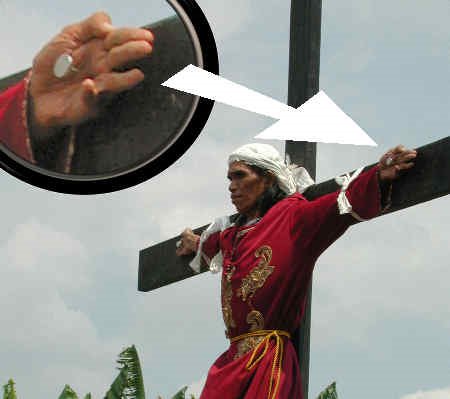 designed and deployed for front page photographs -- they have very large heads, but look at the size of the piercing shaft. Doubtless, it is still an ordeal, though nothing like what the ancient Romans could do to a recalcitrant, rebellious Jew.
On top of this lil bit of fakery, Philippine crucifixion events have become tourist spectacles, attended by both locals and foreigners for their ability to fill up the usually dead hours of Holy Week, when everything shuts down and the populace is on vacation somewhere like Boracay or California. Here we have three Mary Magdalenas, complete with bloody imprints of Jesus' visage, (probably Manileños on a Good Friday visit to Calvary in Pampanga.) As with Christmas, crass commercialization has taken over even the most sombre of Christian holy days. The little burg of Cutud gets a tidy income from the large influx of ogglers and curiosity seekers.

Why does the Roman Catholic Church tolerate these sadomasochistic exploitations of the Passion? Although the institutional Church itself does not participate in, condone or encourage these Lenten week practices, neither does she speak out against them or issue Pastoral Letters condemning the idolatrous mockeries that commercializing Christ's passion and death seem to represent.
Perhaps because these exotic and extreme acts are not at all limited to the peasants of Barrio Cutud, but find analogous practices among the elite, the creme de la creme of Catolico cerrado Philippine society, such as the "Christianist" Opus Dei and its rather, uhmm bizarre articles of personal clothing and accessory. ABSCBN's Ricky Carandang and Pia Hontiveros have a special on the Da Vinci Code and they got to talk to a number of priests and laymen, including Father Michaelangelo Cardenas of the Opus Dei Theological Center at the University of Asia and Pacific. Fr. Cardenas, apparently along with many senior members of Opus Dei, wears a CILICE (pronounced SILL-iss) described by Wikipedia as follows (with a picture) --
In more recent times the word has come to refer to a spiked metal belt or chain worn strapped tight around the upper thigh. This practice has existed in various parts of the Roman Catholic Church, but has become associated in the twentieth century with the Catholic personal prelature known as Opus Dei...The use of the cilice on the upper thigh is a prominent signature trait of Silas, a fictional member of Opus Dei, and one of the lead antagonists in Dan Brown's novel, The Da Vinci Code.SPECULATION: But I think the institutional hierarchy tolerate these mock crucifixions and self-flagellations because as acts of literal, physical imitation of events at the very origin of Christianity, they do proclaim an unquestioning fealty and submission to the Faith (or the Work, as the case may be) and an affirmation of its core narratives about those events. Moreover, I don't think that the Republic as such, has ever enjoyed any equivalent fanatical demonstration of loyalty and devotion to its national legends and myths as spectacular and world-renowned as our crucifixions and self-punishments at Lent (and at other times!) Maybe some Catholic Church leaders find this flattering, or comforting, in an odd sort of way.
CHRISTIANISTS AND ISLAMISTS: Andrew Sullivan produces a lethal neologism, after taking off on an incandescent article by Garry Willis (History Professor emeritus, Northwestern University and author of What Jesus Meant), entitled, Christ Among the Partisans, a passionate defense of why the Catholic Church should stand above mere politics (and fight for what I have called eternal principles --
Some people want to display and honor the Ten Commandments as a political commitment enjoined by the religion of Jesus. That very act is a violation of the First and Second Commandments. By erecting a false religion — imposing a reign of Jesus in this order — they are worshiping a false god. They commit idolatry. They also take the Lord's name in vain.And I haven't even touched on the idolatry of the Filipinos in public life.Some may think that removing Jesus from politics would mean removing morality from politics. They think we would all be better off if we took up the slogan "What would Jesus do?"
That is not a question his disciples ask in the Gospels. They never knew what Jesus was going to do next. He could round on Peter and call him "Satan." He could refuse to receive his mother when she asked to see him. He might tell his followers that they are unworthy of him if they do not hate their mother and their father. He might kill pigs by the hundreds. He might whip people out of church precincts.

